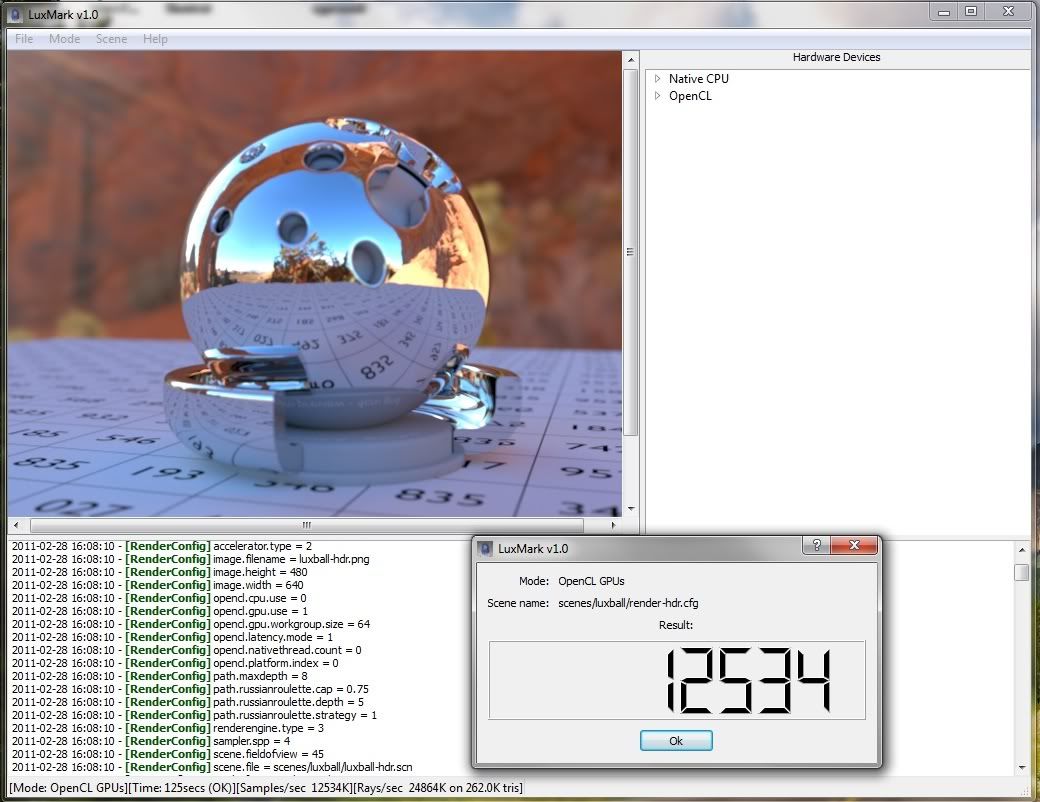
Quote Originally Posted by jogshy View Post
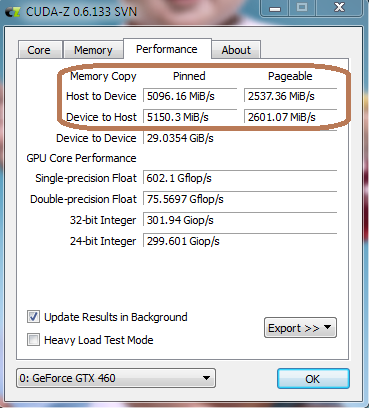
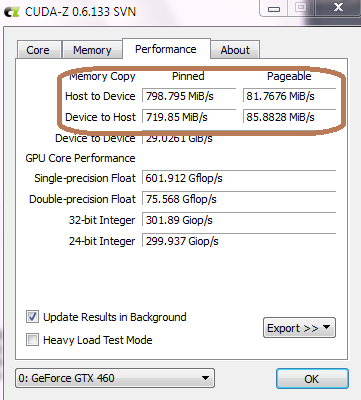
After taking a look at the code, I wonder how dependent is this test on the PCI express. I've been never a big fan of passing tons of data by the bus.
Any of you can make a quick test pls? My BIOS does not allow to change the PCI multiplier... but I bet if you put a monster GPU and you put it to 2x a modest GPU running at 16x might be faster.
Every 5 seconds, the images rendered by each GPU are downloaded to the CPU memory to be merged a drawn on the screen. It is a very little amount of data for the bandwidth of PCIe bus.
I have 2x5870 plus a 5850 installed on a 4x PCIe slot. I have done some test, moving the 5850 between 16x slots and 4x slot: I haven't experienced any performance difference.

Jogshy, anyway we need a feature like GPU-to-GPU direct transfer announced for CUDA 4.0 to solve this problem (if it becomes a problem with many GPUs).

Quote Originally Posted by jogshy View Post
Also, I think the automatically assigned work size of 64 thread/block may cause an slowdown.
A little trick: you can change that value by editing the file scenes/luxball/render-hdr.cfg. Just edit the following line:

opencl.gpu.workgroup.size = 64

Quote Originally Posted by jogshy View Post
So, in my case, the CPU is 2x faster than the GPU... Shouldn't be a GPU faster than a CPU rendering?
i7 920 is more expansive that a HD5750 and the GPU is still faster. I don't read it as a bad result for the CPUs Vs GPUs "holy war".

Quote Originally Posted by jogshy View Post
That's the whole point of Octane, VRayRT and other GPGPU renderers after all...
Jogshy, I assume you are the same of ompf.org forums; you know that there have been a lot of discussion about this point. Many people believe there is a lot of marketing vaporware in CPUs Vs GPUs "holy war".

My opinion is somewhat in the middle, GPUs computing offers great value (especially for home/office users) but it is no where near the 100x faster promised by the marketing.