

Yeah +1.Originally Posted by Daveburt714

I haven't really played with this, I saw a bit on KTE's MSI thread but didn't really take much notice as it wasn't my board.
So an explanation/instructions would be nice thanks KTE.



Yeah +1.
I haven't really played with this, I saw a bit on KTE's MSI thread but didn't really take much notice as it wasn't my board.
So an explanation/instructions would be nice thanks KTE.
I'm honestly short of time and have a non-bootin Phenom with a DOA board and a DOA PS for 3 days, so not in the best position to post, but to answer your qs, all has been shown many times in one place without anything extra. Me and Achim must have posted this quite a few times, all you really need to know is small, trust me. Achim did it fully incl. the bit values needed in the DFI thread, straight from the AMD guide. Check that long quoted post, it's all there.http://www.xtremesystems.org/forums/...&postcount=578
About the MSRs, they are not MB specfic. MSRs are CPU registers, held inside the CPU. When you change them, you change the CPU settings (if write enabled and within specified parameters). Thus if you have a Phenom, all the VID/FID/DID MSRs and their respective value mappings should be the same on any board. They can be found within the Family K10h BIOS and Kernel Developers Guide.
Value mappings, again, a monstrously lengthy task and can v.slightly differ from a board to another (i.e. depends on VRM - vdroop and vdrop you get) so not really feasible to write one by one, refer back to the VID/Volts I posted long ago as they denote the VID=Volts for IMC as well.
Quickly;
MSR C001_0070 decides the current system state.
ALL 96BE's can change VIDs.
95/96 are locked upwards at 1.25VIDs.
MSR C001_0070
EDX 0x0
EAX 0x28003007
Blue Bolded Hex Value = NB VID
Red Bolded Hex Value = CPU VID
That above is at 1.25VID CPU (30h) but around 1.30VID CPU NB (IMC - 28h).
Hex to NB VID
20h 1.350VID
25h 1.325VID
27h 1.312VID
28h 1.300VID
30h 1.250VID (default)
....
34h 1.225VID
35h 1.225VID
37h 1.212VID
38h 1.200VID
39h 1.200VID
40h 1.150VID
41h 1.150VID
42h 1.138VID
43h 1.138VID
44h 1.125VID
45h 1.125VID
46h 1.112VID
47h 1.112VID
48h 1.100VID
49h 1.100VID
50h 1.050VID
52h 1.038VID
Approx. VID to Voltage mappings (without vdrop): http://www.xtremesystems.org/forums/...&postcount=905
That's lowest I've been at 1.8G, my Phenom cannot downclock NB so I can't try lower VIDs on NB.
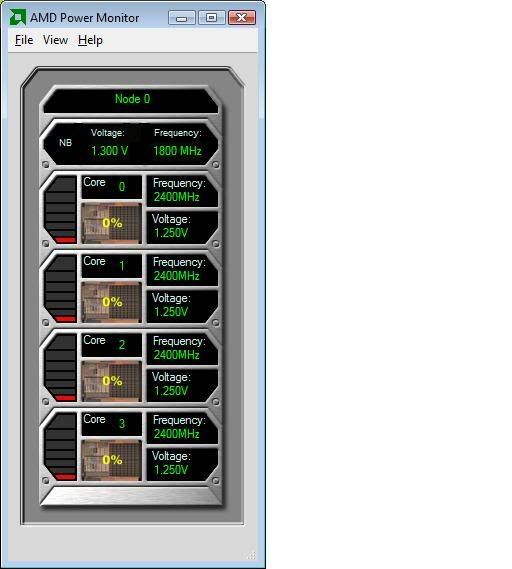
Test 30h-25h NB VID please, its only a copy/paste from read to write, change NB VID number and click on write. Then check AMD Power Monitor (latest one) to let me know what value you get. Guide mentions different to what I was getting. There should be 1.275VID and a few more values I was missing.
KTE thankyou very much for the reply.
I can see the changes that need to be made so it shouldn't be too hard.
The problem I and probably a few others here have, is I haven't used crystal cpu to change these values, so I'm a bit lost as to how to do it.
I looked at your msi thread but there are 1500 posts there now so it's hard to find anything.
Can you point me to a section where it's written or if not can you guide us through crystal cpu.
I don't need this immediately so please don't feel stressed. Just when you have time.
Specifically I need to know where to type the numbers in and how do I access that section of the msr. I typed in C001_0070 in the msr number field but got an error that said something like, "you need to input hex values."
EDIT: Can we actually change the NB VID upwards? I'm using a 9500 and I get the impression you're saying it's locked unless a BE is used.
Last edited by Aussie FX; 03-10-2008 at 04:39 AM.
No problem.
Check this, it was a guide I wrote for the MSI board to disable the patch. How to use Crystal CPUID (easy once you try it): http://www.xtremesystems.org/forums/...postcount=1215
-Just replace the MSR number with 0xC0010070 and hit RDMSR.
-For writing, after you've entered the new EDX and EAX values in the white fields below them, hit WRMSR (fill both fields).
-Check monitoring tool (and hit RDMSR again), values should change for that core (chosen core is shown in Crystal CPUID top right).
Thanks mate, I understand it all now. I tried it without hitting WRMSR and it made sense.
I will do it for real tomorrow as I have just taken some painkillers and I don't want to stuff it up.
I will try those other values for it too.
AMD power monitor says the nb is currently at 1.25v.
BTW I did an edit of my other post so you might not have seen it, but does this work with 9500 or only BE? As I have a 9500.
Ok I went ahead and changed it anyway
I changed 0x28003007 which I thought should change the nb to 1.3v but it's still showing 1.25v in Power Monitor, so I'm guessing I need a BE.
If that's the case do i need to change back to 0x30?
Hello Gentleman
SuperMicro X8SAX
Xeon 5620
12GB - Crucial ECC DDR3 1333
Intel 520 180GB Cherryville
Areca 1231ML ~ 2~ 250GB Seagate ES.2 ~ Raid 0 ~ 4~ Hitachi 5K3000 2TB ~ Raid 6 ~
Post 577#:
i.e. no real change above stock as I mentioned, for 95/96 models. They only go down. BE's for unlocked control.About the MSRs, they are not MB specfic. MSRs are CPU registers, held inside the CPU. When you change them, you change the CPU settings (if write enabled and within specified parameters). Thus if you have a Phenom, all the VID/FID/DID MSRs and their respective value mappings should be the same on any board. They can be found within the Family K10h BIOS and Kernel Developers Guide.
MSR C001_0070 decides the current system state.
ALL 96BE's can change VIDs.
95/96 are locked upwards at 1.25VIDs.
If you're at 1800MHz NB, change it to 32h and see what you get. Should change.
OK 32h gives me 1.237v
Looks like I'm going to buy a BE tomorrow
Last edited by Aussie FX; 03-10-2008 at 05:37 AM.
Dave give this a go, it's a lot easier than I thought, hell I've just done it with a skin full of morphine so you'll be right.
Thanks to the help from KTE.
Try lower. Try up to 1.1VID and stability test it. It should go as low as that if not lower at 1.8G NB.
Max I've had stable is 1.038VID at 1.865GHz.
OK I will save that one for tomorrow though.
I need my wits about me to do that.


You know, I still stand and watch how nicely Justapost figured this out and the info you and he provided... I will be pushing accolades on him for quite a while with that thread.
jack
One hundred years from now It won't matter
What kind of car I drove What kind of house I lived in
How much money I had in the bank Nor what my cloths looked like.... But The world may be a little better Because, I was important In the life of a child.
-- from "Within My Power" by Forest Witcraft
Yep Achim did v.well figuring out 1/2 MSR values for the ASUS and Biostar boards. The values and the TLB button didn't work on our boards for a while but we found the right ones later on and now it all works. He's worked very hard to find the details we required. I must admit the main names going unmentioned are by the guys who figured out and started us on Phenom before we had a clue: lukija, tictac, macci.
So what's the best case scenario for the MA790FX-DQ6? Is a modded bios possible with NB VID adjustments?
Sorry to here about your system problems Bud... I know you have alot on your plate so I really appreciate your help!
I actually saw that post by Just, but it's not quite a language I understand (especially the stuff in brackets, ie: [18:16])... Thats where I got my original info though, Guess I need to study up on register mods.
The only bright side of that is it looks like I did have it right.. hehe...
Nice Aussie, the fact that 32h showed a lower voltage in HWMonitor seems to blow the whole idea that the HW/boards don't support changing IMC VIDS/V's. (Tech support people... Sheez...)
I'm actually going to play with it tonight. I have a 96BE so I'll try pushing NB frequency higher too, just in case HWMonitor gets it's values from reading the MSR registers. I doubt that it does, since it still wouldn't go higher on your non BE...
AMD FX-8350 (1237 PGN) | Asus Crosshair V Formula (bios 1703) | G.Skill 2133 CL9 @ 2230 9-11-10 | Sapphire HD 6870 | Samsung 830 128Gb SSD / 2 WD 1Tb Black SATA3 storage | Corsair TX750 PSU
Watercooled ST 120.3 & TC 120.1 / MCP35X XSPC Top / Apogee HD Block | WIN7 64 Bit HP | Corsair 800D Obsidian Case
First Computer: Commodore Vic 20 (circa 1981).
Hey Aussie... Still playing with it, but thought you might like this ss..
Upping the HTT Ref with AOD is giving me a few problems, but it looks like the board is actually able to adjust the IMC VID higher (as long as you have a BE). Justapost and KTE are my heros...
AMD FX-8350 (1237 PGN) | Asus Crosshair V Formula (bios 1703) | G.Skill 2133 CL9 @ 2230 9-11-10 | Sapphire HD 6870 | Samsung 830 128Gb SSD / 2 WD 1Tb Black SATA3 storage | Corsair TX750 PSU
Watercooled ST 120.3 & TC 120.1 / MCP35X XSPC Top / Apogee HD Block | WIN7 64 Bit HP | Corsair 800D Obsidian Case
First Computer: Commodore Vic 20 (circa 1981).
Good news we can adjust NB voltage in Windows but still that's half-solution at least for me. That's why I wrote nice e-mail to Gigabyte regarding that issue
Lets see what they will replay....
RiG1: Ryzen 7 1700 @4.0GHz 1.39V, Asus X370 Prime, G.Skill RipJaws 2x8GB 3200MHz CL14 Samsung B-die, TuL Vega 56 Stock, Samsung SS805 100GB SLC SDD (OS Drive) + 512GB Evo 850 SSD (2nd OS Drive) + 3TB Seagate + 1TB Seagate, BeQuiet PowerZone 1000W
RiG2: HTPC AMD A10-7850K APU, 2x8GB Kingstone HyperX 2400C12, AsRock FM2A88M Extreme4+, 128GB SSD + 640GB Samsung 7200, LG Blu-ray Recorder, Thermaltake BACH, Hiper 4M880 880W PSU
SmartPhone Samsung Galaxy S7 EDGE
XBONE paired with 55''Samsung LED 3D TV
Ya Bum
I knew you would be able to do it.
That's the advantage of the BE. Now to find out what it does for your overclock.
I nearly bought a BE today but went to the performance shop for my car instead.
I've never bothered with looking towards another.. do it yourself, collaborate, experiment, that is the key, as long as you can
I hope tictac can work out how to disable the chosen core upon boot method, which failed for me, it would be of great help.
I have an old idea roughly plotted, for PCs to include a separate loader and hardware tester/initializer which is what the BIOS now does, then straight after that load up a tiny DSL-like environment overclock and test tool such as AOD, but customed to replicate the mass DFI BIOS OC options. This being a separate code development able to be ran through a peripheral attachment such as USB (mainly a tiny programmable SSD [sub1GB]) and not part of the BIOS, but the BIOS having the option to enable or disable it. I am talking minimal time delay between the BIOS loading and this tool loading straight after, stripped down, no eye candy.
Then, using that software, we choose to load whenever we oc straight after the BIOS, we can have core0/1/2/3/x.. at 0% load in them (unlike in the BIOS), idle, downclock, disable and start clocking and working out full stability before the OS loads. A tool with a combination mixture of EVEREST/AOD/Prime95/Memtest/DFI BIOS. It will need a basic SPi/WinRAR calculation tool inside it to verify if oc parameters have changed, two stability testers for CPU/MEM (maybe 3rd for GFX, but that would get lengthy and complicated) and the obvious hardware feedback mechanism. I believe it would work wonders for oc'ing.
You could take out gfx.
I believe you would want to keep it as slim as possible as we are looking at the cpu in this app after all.
Great idea man!
My E-Mail to Gigabyte from last week is still being processed, normaly i get an answer the next day, hope there is something in progress with a new bios.
Some news to my Phenom, due setting dimm volts higher i can manage to boot Windows at 2.83 GHz but with freezes during surfing the web. Is it possible that the dimm volts have an influence on the IMC voltage ?
Last edited by Boschwanza; 03-12-2008 at 01:47 AM.
Yeah, pity I should've thought of it before 2006 but I quit code development then. Still remember bits of Borland, C and C++ but not much. Mainly because I don't have any need to learn it again now
Boschwanza: how much vDIMM are you talking about?
2.2 V
I tested with the lowest memory divider to make clear that the dimms are not in charge for the freezes.
 Posting Permissions


 Reply With Quote


Bookmarks