

Actually, that's misleading. The processor may be 40% faster on the game, but that doesn't mean the game will be.Originally Posted by 7he ]-[0rr0r




Actually, that's misleading. The processor may be 40% faster on the game, but that doesn't mean the game will be.
wow this thread just keeps burning
E6600 @ 3.6
IN9 32x MAX
EVGA 8800Ultra
750W

Games are more GPU dependent for the most part so I don't believe this supposed 40% gaming performance increase. From either company. Maybe in only a couple games that need gobs of CPU power like supreme commander but for most, most likely not.
The Cardboard Master Crunch with us, the XS WCG team
Intel Core i7 2600k @ 4.5GHz, 16GB DDR3-1600, Radeon 7950 @ 1000/1250, Win 10 Pro x64

Remember how Intel likes to brag about their stuff, while AMD stays quiet...We'd be lucky to get benchmarks of a K10 ES within a week of it being released.
Last edited by perkam; 04-17-2007 at 11:52 AM.
Computer:
Case: Corsair 750D Airflow Edition
Mobo: Gigabyte Aorus X570 Ultra
RAM: Team TForce Xtreem ARGB 3600C14 2x16gb XMP
CPU: AMD Ryzen 5900x
Graphics: EVGA (rip) RTX 3080 FTW3
PSU: Seasonic Focus GX 850w
Cooling: Arctic Liquid Freezer II 360mm
NVMe: SKHynix P41 Platinum, Samsung 980 Pro 2tb
SSD: Micron 1100 2TB, Samsung 860 Evo 1tb
HDD: WD SE 2TB, WD Black 1tb 3 platter with over 10 years of power-on time
actually AMD was talking about K8 over a year before it hit retail and even then it was a knock out
Fast computers breed slow, lazy programmers
The price of reliability is the pursuit of the utmost simplicity. It is a price which the very rich find most hard to pay.
http://www.lighterra.com/papers/modernmicroprocessors/
Modern Ram, makes an old overclocker miss BH-5 and the fun it was
We already have some benchmarks ...
But for server APPS
Low number of benchmarks, but AMD said the average perf of K10/kentfield-clovertow.
I recognize that it is not so much, but it is always better than nothing...
It had a list of clockspeeds. I don't know what you thought the link was for.
Idiocy: Do you have it?
Barcelona is a server chip. Them server admins don't play games.
I think Penryn is coming Q4 07.
When? What? Where?
We have NO k10 benchmarks yet.
No clockspeed, no benchmark
Last edited by WillyWonka; 04-17-2007 at 04:03 PM.
http://www.theinquirer.net/default.aspx?article=38213
Rawr.
Great, so do we randomly choose a clockspeed from that list to match with the AMD performance slides?
Roll-your-own-benches as it were
I laughed hard with this edit Perkam. I think YouTube links also violate common sense rule #45135 in the Internet Handbook
fixed for you.
I think this battle will be about even this round. AMD have a strong CPU and a architectural advantage while Intel has a pure CPU advantage. I'm rather excited to be honest, to see both companies getting close to releasing new chips like this. My money will go to both companies at the end of the year for the first time, I'll buy a a R600/650 and a Penryn.
As for people saying each company is full of crap, they are simply telling the truth in its very best light, you just take it with some salt. I'm impressed with the progress they've both made in the last 24 months.
With the Conroe Intel could be blunt and lay the truth on the line, its nice to see them attempt to continue this trend by giving us numbers that are a little more clear than AMD's. They are becoming more open, true they are still bloodthirsty bastards but this change of pace from the giant has to be applauded.
With Barcelona AMD fans have to remember that the first benches will be shown with the R600, AMD aren't just selling CPU's anymore they are selling an entire package. For once, AMD will have the tailor made chipsets that Intel have had enjoyed for so long.
When the P4 faced the A64 the biggest change seen 12 months down the line was dual core. Now we're facing fusion, the futures bright indeed eh?
Anandtech posted something about it
http://anandtech.com/cpuchipsets/int...oc.aspx?i=2972


intel likes testing in cache-dependent apps -)


Article from the following link
http://www.hexus.net/content/item.php?item=8437
link to the testing under intel's conditions:The Intel Developer Forum (IDF) 2007 has centred around the company's roadmap over the next year or so.
Whilst we've heard it ad nauseum, it's no surprise that Intel's messaging in practically all of the keynotes has centred around the move to a 45nm process technology for its Core microarchitecture. After all, Intel, primarily, is a fab-owning semiconductor company and churning out new, improved processors is the main name of the game.
Gordon Moore, Intel's doyen, has described the move to 45nm production, made possible by the use of high-k and metal transistors, as "the biggest change in transistor technology since the introduction of polysilicon gate MOS transistors in the late 1960s."
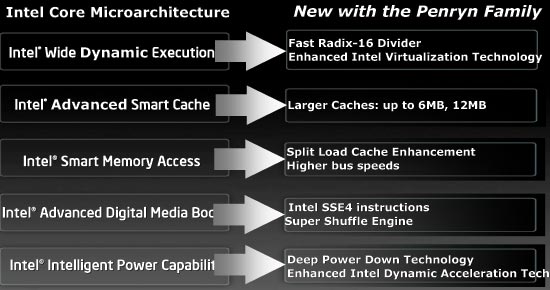
The next iteration of Core, codenamed Penryn, will harness this technology to bolster the architecture with additional features.
Intel is keen to point out that upcoming Penryn processors, be they dual- or quad-core models, are more than just process shrinks. The wonderful 45nm process technology is grabbing all the headlines and key performance-boosting features aren't receiving the exposure they deserve, according to some Intel representatives. The reduction in process brings about no real intrinsic gains; the benefit arises from what it allows you to add in without upsetting the TDP cart, be it cache, extra ISA, or frequency headroom.
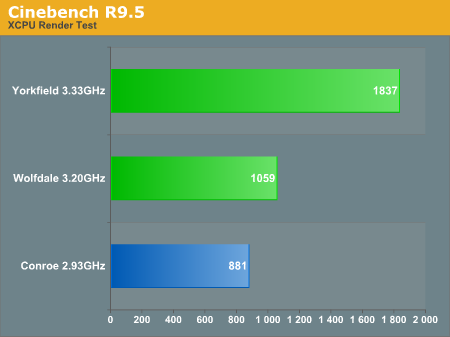
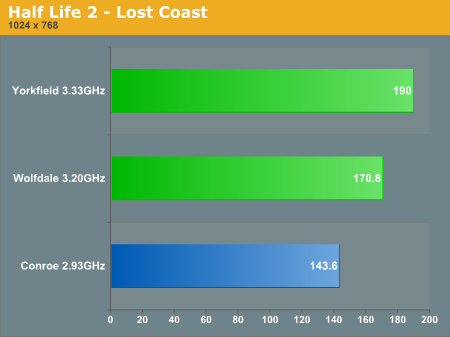
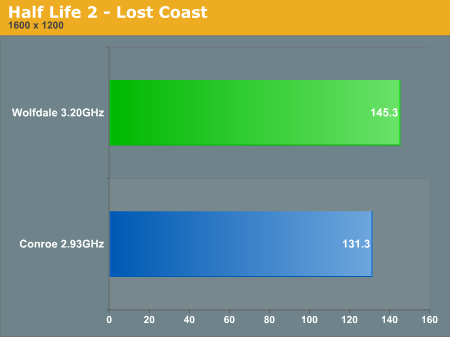
With that in mind, HEXUS was invited to compare the performance of both the dual-core (Wolfdale) and quad-core (Yorkfield) Penryn-based processors, albeit in Intel-controlled conditions. Read on to see if the additional features, which we covered in detail here are worth the upgrade.
http://www.hexus.net/content/item.php?item=8233
*EDIT*
looks they have a few tid-bits on Nehalem proc as well.
Last edited by Deadeye550; 04-18-2007 at 07:17 AM.
you will see it in a week (when AMD will show K10+R600 system)
AMD already has buggy 45nm's, they don't work unlike penryn but exist
PS intel's test system was rinning Vista 32 bit, so I suppose they didn't enable macrofusion technology in 64bit mode
xrenovo
Last edited by MAS; 04-18-2007 at 07:50 AM.
http://dailytech.com/Intel+Unveils+P...rticle6958.htm
Is that a typo by DT? or did Intel decide to change stuff?Intel plans to upgrade the cache on dual and quad-core Penryn-family products. Dual-core Yorkfield processors gain an additional 2MB of L2 cache for a total of 6MB. Quad-core Wolfdale processors, which are essentially two Yorkfield’s sandwiched together, feature 12MB of L2 cache. Intel’s current Kentsfield quad-core processor only has 8MB of L2 cache.
it's a mistake
Inwhich most applications/games will take advantage of
[SIGPIC][/SIGPIC]
umm NO
Most Cache tweaking designs for applications limit themselves to 16kb because anything over that can significantly reduce performance. (Games never design to efficiently use L2 Cache but they make sure as heck they make use of L1)
Fast computers breed slow, lazy programmers
The price of reliability is the pursuit of the utmost simplicity. It is a price which the very rich find most hard to pay.
http://www.lighterra.com/papers/modernmicroprocessors/
Modern Ram, makes an old overclocker miss BH-5 and the fun it was
Actually that's "few" thus my reasoning for using most
[SIGPIC][/SIGPIC]
Tell us more about that. Do they have 32nm and 22nm also?
Entertain us more please.
Does the higher frequency results in lower gaming performance also?
 Posting Permissions


 Reply With Quote

Bookmarks