




Here is my round two effort on testing fans. Round 1 was an attempt at measuring the PQ curve of the fan, but after enough testing I began to see fairly minimal differences across the pressure range and feel that it's not as valuable as focusing in on voltage differences on a fixed radiator. In addition, missing the noise element made the data fairly limited in use. So with that, I've reconfigured my testing method to test on a fixed radiator at a sweep across the applicable voltage options. While doing so, I'm also measuring noise levels as part A of this round.
In addition, I've found that noise level or quantity, is not enough to fully understand a fan, it must be recorded to capture the sound tone or "Quality" of the sound produced from the fan. While doing these videos, I'm capturing CFM and voltage in the background so that you can utilize two videos at a time to make direct CFM to CFM apples to apples comparisons between two fans. In the end, I think this video recording is more important than the dB numbers themselves.
So first up, is part A for the testing and charts, and I'll follow that with the video links for your own evaluation:
PART A - TESTING & CHARTS
Here is the new setup:
I'm purposely measuring noise point blank range at the fan to maximize resolution on the measurement. I wouldn't worry about the numbers as much as the relative differences, my meter may be in need of calibration too, but it's what I have so it's what I'm using.
I don't understand noise well enough yet either, so I'm just measuring at the hip. It's obviously interesting how a 30-40dB spec fan can produce over 70 at close distances. Also my ambient noise level hovers around 47-50db. I'm leaving my regular PC running in the background so that all the measurements I run have about the same ambient noise level. I think this may be more important than trying to measure in total silence which in itself is near impossible to do.
Tools
The radiator is an XSPC RS120. The fan is mounted without any sort of gasket (Finger Tight M4 Screws/nuts), I only place a piece of tape on the noise side to prevent air from causing problems with the noise measurement. I adjust voltage with my Mastech HY3005D lab power supply. Voltage is measured at the plug to the fan to eliminate vdroop in the wiring. Amperage is measured on the power supply display. RPM is taken from my crystalfontz CFA-633.
Test Proceedure
-Mount fan to radiator with M4 screws until nuts are a hard finger tight on all four corners.
-Set sound level meter to edge of fan/radiator just far enough to prevent touching.
-Run fan for 5 minutes to warm up fan and anemometer.
-Reduce voltage to zero to record ambient noise level.
-Increase voltage to 5V.
-Record amperage from mastech PSU, dB from sound meter, RPM from PC Crystalfontz CFA-633, CFM from Anemometer (if >9cfm)
-Increase to 6V repeat recording as noted above.
-Repeat measurements on even volts including 5V, 6V, 7V, 8V, 9V, 10V, 11V, 12V. Voltage held to .03v and measured at fan 3 wire plug.
TESTING RESULTS
Bare with me on the excel default formatting. I'll be working on changing some of the line and marker colors to improve contrast and readability.
Air Flow Vs. Noise
This chart represents a relationship between air flow and noise. It's probably one of the more important relationship folks are looking for, although I would caution about noise numbers being what they are. Noise quantity does not equal noise quality and that's something not presented here. Many of the 38mm fans seem to present better here, although subjectively I think their noise quality is lower than the 25mm fans. You can also get a sense for how strong or powerful a fan is by how far the lines extend upward on the air flow scale.
Regardless, the Gentle Typhoon is presenting well here with it's unique fan blade design. It does present a different tone than most of the fans, sort of a sound all of it's own. Other fans seem to rate relatively poorly that doesn't really fit with my own perception. The noise blocker fans seem to have a good smooth sound in my own perception, yet they measured higher numbers of noise quanity compared to others.
I would fall back to what I understand from noise level.
3db differences are considered "Barely perceptible". I've also probably got 1-2dB error in testing, so I wouldn't necessarily consider anything significant unless the difference in sound is more than 5dB.
Here is the big overall chart:
And one zoomed to better see lower speed areas:
Radiator Air Flow Vs. Voltage
This is purely performance only showing you how much air is pushed through the radiator for various amounts of voltage. Generally the thicker (38mm), the higher the RPM, the more curved shaped blade, and the more number of blades produces more power. The Delta AFB SHE 38mm nearly 4000RPM fan is clearly king here producing nearly 10X the amount of air as some of our slowest speed fans. Of coarse all that comes with ALOT more noise, but we're not looking at noise in this chart.
Air Flow Vs. RPM
This is more of a measurement of fan blade power or efficiency per RPM. The important thing here is to understand that there's a fairly good range of performance for the same RPM. Some fans have a straighter blade and require more RPM for the same CFM, etc.
The San Ace with it's 38mm thickness and curved blades is producing the most per RPM, followed by the Gentle Typhoon.
Noise vs. RPM
And this is the noise measurement per RPM. Some fans tend to produce more noise per RPM and this could be a combination of the fan blade making the noise as well as the motor. There appears to be some give and take between CFM and Noise per RPM with many of the fans, but some seem to do both pretty well.
Noise Vs. Voltage
This chart is all about noise "Quantity" and nothing more, again I would caution that noise quantity is different than quality. This does not quantify the "motor Ticking" or other types of "irritating" noises that you would consider when comparion the noise of one fan to another. The Ultra Kaze 1000, the LED version of the Yate Loon D12SL12, the Noise Blocker XL-1, and straight blade yate loon D12SL12 are among the more quiet fans. Again this is just noise quantity, not quality or tone!
RPM Vs. Voltage
This is just a simple look at RPMs. Some fans have an ability to reach fairly wide ranges of RPM, while others are more specifically designed for one area only. This should give you some sense of the fan's ability to change RPM by varied amounts of voltage.
Air Flow Vs. Power Consumption
This is likely not of concern for most users, but I have seen a few fans claiming to be environmentally friendly regarding energy efficiency, so I thought I'd plot this comparison. It is a relationship of energy efficiency vs. air flow produced. This should also give you a sense of power requirements for fan controllers, etc.
Also some fans like the nanoxia, claim to be a "Green" fan. It is green in color, but it was more of average than a top electrical efficiency fan. The Gentle Typhoon and a few other were generally more electrically efficient.
and a closer up..
Part B - VIDEO RECORDINGS FOR YOUR OWN NOISE QUALITY REVIEW
To help with the problem that noise level doesn't necessarily fit with noise quality, I'm including some video recordings to capture the fan's particular noise quality traits. I'm testing on the same platform and recording the CFM and voltage in the video for reference. The only difference is I'm not adding a piece of tape to seal (Between Fan/Rad) since I'm not measuring noise level. This may result in slightly lower CFM numbers than the charts, but they are all tested equally the same, so the CFM numbers on the videos are good relative numbers. Anyhow, pay particular attention to the sound tone and motor ticks when undervolting. These are important traits I don't think you can capture in a number and I feel are much more important the the dB number I've included in the charts. Note that the anemometer isn't very accurate until about 10cfm, number below that are not to be trusted, you'll see what I mean when you watch the video.
Note that the JVC camera used does have automatic gain control, so these videos should not be used to compare sound level, they are only good for tonal characteristics and quality...not quantity.
VIDEO LINKS
ADDA HB = ADDA AD1212HB-A71GL
http://www.youtube.com/watch?v=7FlZvjwMySc
Delta AFBSHE = Delta AFB1212SHE
http://www.youtube.com/watch?v=IgHKP_mBZJg
Gtyphoon AP15 = Servo Nidec Gentle Typhoon DC1225C12B5AP-15
http://www.youtube.com/watch?v=bLgJomTh74w
Kool25MBK = Koolance Fan-12025MBK
http://www.youtube.com/watch?v=QEM1IhBQ2xU
Kool25HBK = Koolance Fan-12025HBK
http://www.youtube.com/watch?v=Ji-f9ywCcqM
Kool38HBK = Koolance Fan-12038HBK
http://www.youtube.com/watch?v=MiNcYXlVTKk
Panaflo M = Panaflo FBA12G12M
http://www.youtube.com/watch?v=fqMWeTYLrD4
Panaflo U = Panaflo (NMB MAT)FBA12G12U
http://www.youtube.com/watch?v=kmfJpveSOjk
San Ace H1011 = Sanyo Denki San Ace 109R1212H1011
http://www.youtube.com/watch?v=-dCBSux7cvc
Kflex M = Scythe Kama-Flex S1225FDB12M
http://www.youtube.com/watch?v=wLVYsJ8SStQ
Kflex H = Scythe Kama-Flex S1225FDB12H
http://www.youtube.com/watch?v=MP1pVShKyRk
Sflex-E = Scythe S-Flex SFF21E
http://www.youtube.com/watch?v=RcJ4Yr2krTk
Sflex-F = Scythe S-Flex SFF21F
http://www.youtube.com/watch?v=5ygYCWhwP7c
Sflex-G = Scythe S-Flex SFF21G
http://www.youtube.com/watch?v=rrtRQD2q1vM
SlipStream SH = Scythe Slip Stream SY1225LS 12SH
http://www.youtube.com/watch?v=UO4Tk2FzZBs
ScyUK3 = Scythe Ultra Kaze 1000 DFS123812H-1000
http://www.youtube.com/watch?v=uMNxyDxmgAE
ScyUK3 = Scythe Ultra Kaze 3000 DFS123812H-3000
http://www.youtube.com/watch?v=Gb-0usGR-Ok
Nanoxia FX2000 = Nanoxia FX12 2000
http://www.youtube.com/watch?v=3NWkB0U6UOU
NB XL-1 = Noise Blocker XL-1
http://www.youtube.com/watch?v=3stzdNw0K0s
NB XL-2 = Noise Blocker XL-2
http://www.youtube.com/watch?v=yvX_z9OzI0M
NB XLP = Noise Blocker XLP
http://www.youtube.com/watch?v=YWU1ptI8J7E
NB S1 = Noise Blocker M12 S1
http://www.youtube.com/watch?v=PXCjqxmS3mM
NB S2 = Noise Blocker M12 S2
http://www.youtube.com/watch?v=1GNDu5Fn5bg
NB S3 = Noise Blocker M12 S3 HS
http://www.youtube.com/watch?v=JrYiC9Xq8uw
SilverStone 25BU = Silver Stone (Everflow) R121225BU
http://www.youtube.com/watch?v=257bRrU--Z0
Thermaltake TT-25 = Thermaltake TT-1225 (Thunderblade)
http://www.youtube.com/watch?v=0TEWJ5Ibz34
Yate SL-C = Yate Loon D12SL12 Curved Blade
http://www.youtube.com/watch?v=909stCuDbtM
Yate SL-S = Yate Loon D12SL12 Straight Blade
http://www.youtube.com/watch?v=bA0bGsC1VLw
Yate SL-LED-S = Yate Loon D12SL12 LED version with Straight Blades
http://www.youtube.com/watch?v=QAqIY_S4aT8
Yate SH-C = Yate Loon D12SH12 Curved Blade
http://www.youtube.com/watch?v=eCLssN0yQ8U
Zalman ZM-3 = Zalman ZF1225ASH
http://www.youtube.com/watch?v=m7Yy3U2QYdo
Testing accuracy and Repeatability
I'll be checking some more results after I get the last couple of fans done, but I have included two tests on separate days of the GT AP-15 to give you an idea (In the first chart). My ambient noise levels varied to some degree, but I believe measuring very close to the fan eliminates most of that error for measurments several dB higher than ambient. Noise levels in the 50-55db range would be more suspect. Anyhow, for a hobby built test rig, I'm generally pretty happy the results are at least looking good from a relative sense. I would not take any of the actual numbers as absolute, the CFM is arbitrarily calibrated per a fan, so I know there's error there, I believe I'm reading high CFM if anything. My noise meter is also just a cheap meter, so I'm not sure it's accurate. In a silent room my sound level meter will only read down to about 39dB which is the limit of the meter. This is why I chose to keep a constant background noise present which kept the ambient noise level in the range of 47-52dB.
Bottom line, the equipment is cheap, not lab grade and only good for relative comparisons. I would also like to reiterate that noise quantity in dB is not the same as noise quality, don't take the dB numbers as a definitive measurement of good vs. bad, the only way to be absolute there is to try each of your preferred fans and decide for yourself.
Summary
There are alot of good fans here and considering the human ear is only capable of sensing 3dB rises as "Barely Perceptible", I would consider that a good indication of why fan preferences are so varied. They all have similar noise characteristics. I think I have collected a good group of performance numbers, particularly the CFM vs Volts chart, I would use that to give you a sense of fan powers.
Subjective Notes
I don't necessarily think there is a means to accurately identify which fans are necessarily better than others that would be agreeable to all. There is far too much personal preference that determines which tone or characteristic sound and power requirement is desireable. With that said I see several generalities:
-Motor noise is generally smoother the smaller the fan motor hub, but also a higher pitch. 38mm fans with the extra large fan hub general have more of a pulsing or motor ticking type of sound when running very low rpm levels. This measures low from a dB standpoint, but it's a noise that many may not like...you really need to listen to the videos to see that.
-Noise tone and quality often times varies across the voltage range, sometimes it can even get worse at one voltage and get better with a higher voltage, it's one of those sound dynamics that occurs.
-Fan generally produce more CFM per RPM the thicker the are, the more curved the blade, and the more number of blades.
-There is no consistency between fan families. I've seen several cases where the same series of fan has very different sound responses, you simply can't depend on consistency there.
-It gets really really hard to choose between fans in the ultra silent 1000 or less category. My instruments were simply not able to measure CFM levels that low and to my ears, they are all silent down at that level.
Recommendation
As much as I've tried to quantify things as scientifically as I'm able to with the equipment I have, I would emphasize that you listen to the videos as the primary means to compare fans and make your own personal preference choice. A really handy way to do that is to start up two window browsers with a video in each window, then use the sliders to match up similar CFM levels and pause each movie. Then go back and forth between each fan and see which one you like the sound tone of better. I think this is different for everyone, and you should make your own decision on what you like...not what I or anyone else likes. You can also use the charts to understand things like how powerful the fans are, what RPM range they can produce, power requirements, etc....but I'd use the video as the main tool here.
Final Notes
If I had to pick just one fan for my needs. I want something very quiet, but something that also has a decent amount of performance. While being a bit on the ugly side, the Gentle Typhoon AP-15 gets my top pick for producing the most CFM per noise level and quality of the fans tested. 9 volts in particular is my favorite spot which is still producing a good 22+ cfm on the radiator.
For the high speed stuff, I'll give my kudos out to the San Ace. I still think it has that common 38mm fan motor noise when undervolted, but it's the smoothest of the bunch from what I can tell.
As far as the <1000 RPM range, I think all of the fans (except the high speed 38mm fans) are good and really hard to separate. I couldn't really measure CFM below 10CFM, so I really couldn't tell you much with my test setup other than CFM is pretty crappy down there and you better plan on many times more radiator than someone with strong fans.
Bottom line:
King of Power @12V = Delta AFBSHE
King of Low Noise @ 12V = Noiseblocker S1
King of CFM per Noise Level/Quality = Gentle Typhoon AP-15
And most importantly...
I wanted to give a HUGE thanks to Hondacity, Alex from Petra's, Linus from NCIX, and Martin from feser-one for donating these fans to test. Also KaptCrunch for helping me out with the sound meter. This test would not have happened without their generosity..
THIS TEST IS DONE!!
Update 5-19-09:
John from Madshrimps cleaned up my mess of data in a nice fan by fan with video layout here as a rehost for you in an easier to follow layout with detailed graphs for each fan, thanks!
Update: 9-7-2010
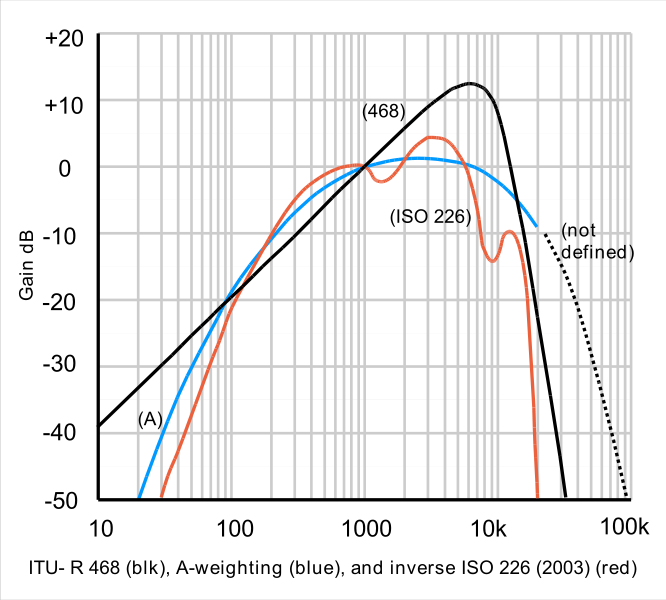
In pursuit of learning more about audio and noise and attempting to quantify noise quality..., I did some experimentation with extracting noise profiles from the recorded audio of the original videos taken in part B. I've also been playing around with weighting curves. Here is a chart defining various "Weighting" standards, most common in the us for environmental use is the "A-weighting method. It's basically just a method to make pressure levels better fit what the human ear perceives as noise. For example, we're much more annoyed by a tone at 3KHz vs 100Hz, so it gives those frequencies more emphasis.
One particular area, I'm finding more about doing some noise profiles is AGC (Automatic Gain Control). Some camcorders have what is called automatic microphone gain, in which they adjust the microphone gain on the fly. I'm finding through this research and spectrum work that the JVC camera I used did in fact have some microphone gains done automatically on me during my recording work. This was found by doing a spectrum analysis on the blank portion of the videos. It appears I had most of the videos fit in one of two gain levels separated by about 10dB. Unfortunately this means you should NOT NOT rely on the sound output of the video as a means to evaluate noise level, you can only use them to listen to tonal and or rythm sound quality differences. My JVC seems to have somewhat randomly selected different microphone gains on different recordings, each of which is pretty much exactly a 10dB separation. Not sure why and there is no way around this, but you should be aware of it regardless. Here is a small sample of the microphone profile from the beginning quiet portions of each video:
Below I tried to correct out this microphone noise and difference from each profile... basically took the microphone hiss noise with ambient noise profile and subtracted that from the fan recording, the adjusted it per the A-weighting curve to give additional emphasis on the 1-6K region. At this point I don't know if that's good or bad or completely wrong to do all together...just an experiment as I learn more about audio. This is what that little experiment gave me so far. I suppose it's more accurate than not correcting at all, but noise levels are a bit more complex than simple addition/subtraction. I'm not quite sure if a +10 microphone gain automatically equates to +10 across the board, or something different.
Anyhow, I am still quite impressed with the Gentle Typhoon's "Different" noise profile compared to the others (regardless of this profiling effort), but many have also noted that they really like the San Ace best. This is a good example to emphasize how sound quality preferences differ between individuals. What you or I or the next guy likes, doesn't really matter. We all think a little differently when it comes to noise, and in the end regardless of any detailed scientific efforts to quantify noise.....it's still EXTREMELY SUBJECTIVE and you should decide for YOURSELF!..
UPDATE ROUND 4 TESTING 9-25-2010
Building upon what I learned previously, plus having access to much better video/audio tools. I made a mini 6 fan test including the following:
Here are the videos in no particular order:
Fan Test 4 Yate Loon D12SM12 Curved Black
http://www.youtube.com/watch?v=vILqRsVDqX8
Fan Test 4 Servo Nidec (Scythe) Gentle Typhoon D1225C12B5AP-15
http://www.youtube.com/watch?v=8AmF1Z0M8JY
Fan Test 4 Rosewill DF1202512SEMN BlueLED Clear
http://www.youtube.com/watch?v=mLXsDcQvRS4
Fan Test 4 Rosewill DF1202512SEMN Black
http://www.youtube.com/watch?v=hE48YxQwnOo
Fan Test Round 4 - Noctua NF-P12
http://www.youtube.com/watch?v=uuTm9XysZVA
Fan Test 4 Silverstone AP121 HA1225L12SF-Z
http://www.youtube.com/watch?v=Cec_HlQK4IQ
Please use the videos to compare noise quality differences. I liked the GT and Noctuas as the high end and the Yates as the budget fan, but I'd suggest you decide for yourself.
Cheers!
Martin




 Reply With Quote




 Originally Posted by Hondacity





Bookmarks