





The Showdown at High Noon: Part I
After considering canceling these Showdown articles due to the time commitment and effectiveness of them, I received this reply (from an honorable forum member who I respect):
“If you weren't willing to back up your resuts with solid testing methodology, and some scrutiny from the members here, why start all this BS?”
I mean really, how could I just up and :banana::banana::banana::banana::banana: away into a dark corner after that ? And yet if I uphold my end of the bargain, then I have a request of my own at the end of this post.
.....and Therefore, let the show get started!
Well, fellow watercoolers, the time has come for the gunfighters. Plain and simple, we need to see who is left standing after some head to head contests. Chipset waterblocks, stand and holster, and head to the main street; your time has come. CPU and GPU waterblocks, finish up your drinking soon, your time will come this week as well too.
Before the bullets start flying though, you may wonder who I am or why I am testing watercooling components. You can read more about me and my interest in watercooling at my earlier post here http://www.xtremesystems.org/forums/...d.php?t=151720
If you have not had the chance to read the first article in the series, then look here http://www.xtremesystems.org/forums/...d.php?t=151955
In that article, I learned (don't know if any anyone else learned anything, but I did) that your Core 2 CPU should be fine if your pump fails and that the money spent on setting up two pumps in series would likely be better spent on an upgraded graphics card, more memory, etc......
You may wonder why I have decided to go ahead and post this article after having deep reservations about doing so (and almost canceling the series) and I will comment on this at the end of the article. Likewise, I have included some info on how the testing was performed and why I am publishing the results that I am, at the end of this article as well (but it is rather boring, hence its place at the end).
.....And now, let's see if we can't get a good roadside seat to the showdown!
Chipset Waterblock Showdown
Danger Den Maze 4 versus Swiftech MCW30 versus EK nf ver 1.1
Well, it's been said that a chipset block is a chipset block and that most of them are fairly restrictive. In that vein, first a look at flow thru a typical type loop.
Test 1 – In this test I measured the flow thru the block in what seems like one of the more common loop options seen here at XS: Swiftech Micro Res ¾ full -> 10 inches tubing (see testing section at the bottom of the article) -> MCP655 (vario set at #5 (4800 rpm) at 12 volts) -> 20 inches tubing -> Swiftech MCR220 -> 14 inches tubing -> Dtek Fuzion CPU block -> 8 inches tubing -> Chipset Waterblock (one of the three mated to the SPP northbridge) -> 8 inches of tubing -> Swiftech MCW60 GPU block -> 10 inches of tubing -> back to Micro reservoir. This was done in a room where the temp was held constant at 24 deg C.
Result 1 – MCW30 1.42 gal/min
Danger Den 1.33 gal/min
EK nf 1.1 1.25 gal/min
Test 2 – Same loop as above, only now the chipsets have beens setup on the MCP southbrige and I am measuring the temperature from the P29 BIOS of the 680i chipset at 1.5 volts (from the BIOS or Nturd) with each result shown, being the actual average of five mounts (for each respective Chipset block)
Result 1 – Danger Den 36 deg C (and the Q6600 rose from 41 to 43 deg C with the 8800 GTX rising from 47 to 49 deg C)
EK 36 deg C (same Q6600 and 8800 temps as the Danger Den)
Swiftech 38 deg C (Q6600 rose to 43 deg C bordering on 44, and the 8800 hit 50 deg C) (just a quick note here, as a forum member noticed, the readings here for the Q6600 and 8800 should actually be going down rather than up if the MCW30 is a tiny bit worse at cooling than DD or EK - however, sometimes you just run into anomalies and so even though this is odd, I had to report it. Do enough experiments and you will find this from time to time. We will see this again in the CPU block testing)
The mounting for all the blocks during the temperature testing was accomplished using Danger Dens posts, fiber washers and springs (which worked excellently with all three blocks)(no hard mounts were used except when examining torsional stiffness (below)). The supplied Danger Den springs were compressed to a height of 7 mm for each of the three blocks, and for each of the five mountings on that particular block (15 mountings total over three days). The burn-procedure consisted of placing a 1/2 pea sized drop of Arctic Silver 5 on the MCP, mounting the chipset block and then allowing the computer to run at idle (Q6600 at 3.2 GHz, RAM at 1200, 8800 GTX at 630/1900 with Win XP SP2) for one hour and then temps were taken at the one hour, two hour and three hour marks.
Much of the testing was done (see methodology at the end of the article) on a EVGA 680i A1 motherboard with P29 BIOS. This is probably an excellent choice for chipset waterblock testing since the 680i really can fill in for your space heater. Live in Minnesota, Canada or Scotland and like to keep toasty during the long winters, just buy the 680i and sit beside it. Even better, just apply some pressure and bend over the supplied heatpipes to meld with the underbelly of your toaster frame, and when your BIOS posts, your toast can pop up as well! Really, I feel sorry for all the board partners that had to pick up this design. It is true, that it is EVGA's fault for the crappy TIM gum that they slapped on the MCP and SPP but the real blame here for 95% of the weird problems, are the electrical engineers at Nvidia's chipset division (or the greedy SOBS in marketing who are pushing them to produce this type of detritus without sufficient QC)
Test 3 - Same loop as Test 1 with addition of a water temperature diode circuit (1.2005 mV per degree Fahrenheit) with analog to digital output at one inch after the respective chipset block.
Result 1 – Danger Den 32.9 deg C water temp
EK 32.4 deg C
Swiftech 31.4 deg C
(if these results appear to be ass backwards to you based on the results in Test 1, remember that the good waterblock wisks away more heat)
Test 4 – Same as loop in Test 2 above, only now the pump is connected to a variable resistor (variable DC power supply same effect) that allows me to adjust the flow thru each block to 1.25 gal/min (this is the crucial experiment where block design makes itself known)
Result 1 - Danger Den 37 deg C
EK 37 deg C (bordering on 36 deg C)
Swiftech 39 deg C
and with the water probe
Result 2 – Danger Den 32.7 deg C water temp
EK 32.4 deg C
Swiftech 31.0 deg C
Test 4.5 - I have added this test after the fact (and as an addendum) to this post because this is what I am currently running (although with a different radiator). This shows the effect of two chipset waterblocks on both flow and compenent temps. The loop here is the same as in Test 1 although there is now a Danger Den Maze 4 chipset block between the Fuzion and 8800 GTX and a Swiftech MCW30 between the 8800 GTX and Micro-Res.
Result 1 - Flow for a loop with two chipset blocks = 1.18 gal/min with temps of 44 deg C on the Q6600 (3.2 GHz) and 51 deg C on the 8800 GTX (630/1900) at idle.
Test 5 - Let's look at the pressure drop curves:
Result 1 – MCW30 at 1 gal/min flow = 0.21 psi
at 1.5 gal/min = 0.45 psi
at 2 gal/min = 0.95 psi
at 2.5 gal/min = 1.65 psi
DD Maze 4 at 1 gal/min flow = 0.29 psi
at 1.5 gal/min flow = 0.62 psi
at 2 gal/min flow = 1.5 psi
at 2.5 gal/min flow = 2.10 psi
EK nf Ver 1.1 at 1 gal/min flow = 0.31 psi
at 1.5 gal/min flow = 0.70 psi
at 2 gal/min flow = 1.71 psi
at 2.5 gal/min flow = 2.46 psi
As an aside, there is a measure of optimal turbulence within any block that gives to the best cooling performance (and figures in critically with the debate over whether pump head or pump flow are more important to us watercooler's low pressure/low temperature systems, but that is a long post for another day). Obviously, modeling the correct transition point between laminar flow and turbulence within enthusiast waterblocks was not really an important factor until about three years ago when the Pressler chips came out. The Core 2 and X2 chips are an improvement but when engineers or enthusiasts try to increase turbulence within the waterblock by including acrylic or delrin plates machined with 'accelerator nozzles', they are maximizing the low momentum diffusion and high momentum convection of the coolant (at the risk of decreasing flow, but more on this later). From an engineer's prospective, optimal turbulence modeling is governed by the Navier-Stokes equations, which are nonlinear PDEs. Being nonlinear with no finite algebraic solution, they must be solved thru numerical analysis or calculus of variations methods. For the average engineer or technician this means running computational fluid dynamics (CFD) software which simulates 3D flow. (which to the non-interested, means workstations cranking out calculations)
The Navier-Stokes equations have an interesting history and may be something worth checking out if you are interested in hydrodynamics. They are thought to model phenomena as complex as the bands of Jupiter's atomsphere and the atomsphere here on the Earth, the convection of heat in the world's ocean currents (and thus play a critical factor in global warming research) and the eddies of an aircraft wing. The reason why they are 'thought' to model these phenomena and not 'known' to model them, is because the precise 3D solutions for given sets of boundary conditions are not known.
Incidentally, if you think that you know what these precise 3D solutions are, and your PowerBall lottery tickets keeping coming up zero, then take a look here http://www.claymath.org/millennium/N...kes_Equations/ The Navier-Stokes equations are one of the seven great challenges laid down for twenty first century mathematicians and engineers. Solving these equations could lead you to claim the one million dollar prize (seriously). And think about how much swag you could afford with your new found riches. Hell, you could have seven loops with multiple RD-30 Iwaki's in each loop. Orgasmic !!!!!!!!
Test 6 – Torsional stiffness was measured with a jimmy-rigged setup that consisted of a digital pressure probe and the waterblock in question being either rotationally or vertically accelerated while force was applied to two eight inch clearflex tubes coming out of each block, while it was attached to the 680i SPP.
Result 1 – Well, it didnt work worth a dang. My pressure probe kept moving around and it was difficult to have repeatability with the force applied to the clearflex tubes. I should have repeated this with a better setup but I just had to get other things done. I can say though, that Swiftech's hard mount kit was excellent, as was the four post acrylic Maze 4 top. The EK less so.
After having done this though, I have to say, what's up with the close barb spacing on the Swiftech, EK, D-tek and other blocks and the crummy plastic barbs on the Swiftech stuff ? Many of us watercoolers live in America, where we drive big SUVs, eat big burgers, live in big houses, dislike France and have big bellies. (wink, wink) Seriously guys (Gabe), we need blocks with the barb outlets spaced far enough apart so that we can comfortably fit ½ inch ID/3/4 inch OD tubing with nylon snap grips on both barbs (currently not possible with the D-tek Fuzion, MCW60, MCW30, EK nf Ver 1.1 and many others). In addition, the Swiftech plastic barbs are too long, which increases torque greatly with ½ inch ID tubing (ole fulcrum and lever principle). Yes, I know, you guys use the plastic barbs because of the cost ratio and to accommodate more setups, but every block sold in America should come with two ½ inch OD D-tek brass fittings (notice, I said 'D-tek'). The Swiftech plastic barbs are also hell to get tubing over. If you have to, just increase the price $4 for each block; it's worth it.
So who is the Wyatt Earp of this bunch? Well, hey, they are chipset blocks and there just isn't that big of difference between them. For the particular application of the 680i SPP, I found the Danger Den Maze 4 chipset block bottom matched to their acrylic four post top to be the best performer in terms of flow, temps and mounting with the four posts. For, the less intense heat of the 680i MCP, I found the MCW30 to have the most secure mounting and compatibility with SLI setups, so I would have to give it the nod there. I tried to get wattage numbers from Nvidia for the MCP and SPP (and/or I could due a back calculation from the delta T, but was too lazy) but they return phone calls as often as Heidi Klum shows up at my home in her thong. Overall, by a very slim margin, if you do not run an SLI setup, I give the nod to Danger Den. For SLI setups or two hole mounts the Swiftech MCW30 runs a very close second.
Winner by a hair: Danger Den Maze 4 with the 4 post 680i acrylic top
So it seems that the perfect chipset block does not exist currently, and yet we have just discovered what would be necessary to make it: a good wide copper or silver base with a pinned low restriction inner chamber, low profile acrylic top for use with SLI setups with widely spaced barb mounts for ½ inch ID tubing, hard mount ability with the option for two or four posts and two D-tek metal barbs. Now where do I buy one of these at?
.....And now, that the bodies are being pulled from the streets, it is time for a tune from Hank the fiddler, and a story shall we (or rather just an exchange):
(the following are some excerpts taken from another forum, with the names changed to protect the unfortunate)
Friendly Guy: Hey SWD, that new ABC waterblock looks rad. What kinda temps are you pulling with that in your loop?
Super Watercooling Dude: Well, when I got it setup, ambient in my house was 24 deg C. But this block allows me to push my Core 2 down to 20 degrees C! You wouldn't believe how much I can overclock now.
FG: No way!!! Are you using some type of TEC setup or a Vaporchill with it? Temps like that are hard to believe. I wonder if I could use the ABC to get my temps down to around 18 deg C?
SWD: No. No TEC, whatever that is, and no Vaporchill. I don't have $800 for one. It is just that this block was designed with such cool computational fluid dynamics that the block actually creates a zone of maximum inertia allowing the water to absorb more heat than it normally would, I think. Really cool how people design this type of stuff.
FG: Do you have any precipitation forming around your CPU socket?
SWD: I dont know, cant see down there to it very well. Is it something I should be worried about?
....Ahh, for an enthusiast who knows their stuff, really, this is high comedy. Maybe not up there with History of the World Part I or Blazing Saddles but funny stuff nonetheless. 'Maximum inertia' deserves a spot right up there with the keywords 'military plating' and 'galvanic corrosion' that I see here at XS. Can you just see Gabe of Swiftech on the phone with his design team saying, “No, no, no! That crappy ole plating process they use on ball bearings under extreme pressure and 800 deg C just wont do! Get General Pace on the phone, I need to know the specs on the 'military plating' that they use on those tank busting weapons. Yeah, only that will stand up to the incredible 3.7 psi pump and extreme galvanic corrosion that I expect to take place in these waterloops.” (wink, wink)
Okay seriously, before I get a flood of posts, attacking my sense of humor and/or listing all the specs for military plating, please wait a week or so and I will get to galvanic corrosion and military plating (they both exist but their value to us watercoolers is another matter).
.....Okay, Hank, shut that fiddle down for a moment there, so we can hear ourselves talk
Well, after all that testing, I guess I could just call it quits (I had planned to get to the pumps in this article, but will save that for tomorrow or Thursday), but really, what would a Showdown article be if we didn't look at some more watercooling myths.
Watercooling Myth #4 – If all three of my Iwaki RD-30 pumps in series fail at the same moment, my super duper watercooled graphics card will burn up, putting me out of my ability to run my normal industrial strength graphics software package, that is the main reason I purchased this five hundred dollar beauty (wink, wink).
Test 1 - Dell 4600 system from January 2004 with anATI 9800XT graphics card mounted to a Danger Den Maze5 block (with ATI mounting kit) with the MCP 655 pump NOT running.
Damn Quick Result 1 – What the hell you know, an almost Jim Bob style blowout took place! The temp got up to 111 deg C before the screen went dead. Looking down in the open case showed two expanded tubes coming off the MCW60 and both were clearly leaking water onto the Audigy SE soundcard below (although, in my rush they had not been secured with nylon snap rings). Carefully removing the 9800 XT and placing in an AGP slot in another lab computer proved that is was indeed dead as a doorknob. Damn shame too, since I now had to stealthy replace it back in my lab partner's workstation (shhh, shhhh, what happens in the lab stays in the lab).
Test 2 – The Poseidon AS system (see testing section below for specs) with a BFG 8800 GTX graphics card with the MCP 655 pump NOT running.
Result 1 – The 8800 GTX got up to 96 deg C in Nturd before the screen went black. Looking into the case revealed that the nylon snap rings were still in place and that the tubing did not blow out.
Result 2 and 3 – Rebooting the computer with the pump back on showed that the 8800 GTX was fine, so naturally, this was Nature's way of telling me to try it again. Two more attempts produced the same result with the GTX recovering after over each overheat but looking into the case did show that the tubing had bowed slightly but not blown out on the left barb (water leaving the GPU block), so maybe I do need to eat some crow. Incidentally, I will soon be looking at the pressure it takes to cause a blow out on unsecured tubing versus tubing with nylon snap grips and metal worm clamps.
Conculsion – The health of your graphics card in the event that your pump fails largely depends on the model you own. I suspect (without exhaustive testing to back me up) that the Nvidia 8800 and ATI 2900/2600 cards will shut down down correctly to protect themselves but that older cards may not. Cooling your GPU is therefore something that I would rate as more risky than watercooling your Core 2 CPU. So, do be careful with the GPU.
Watercooling Myth #5 – Placing a 90 degree elbow in my loop will kill my flow.
Test 1 – Same loop as described in Test 1 for the chipset blocks above, except without the chipset waterblock and NO elbows.
Result 1 – Loop 1 flow = 1.81 gal/min
Test 2 – Same loop as above only there is now a 90 degree nylon elbow in between the Fuzion and MCW60 blocks
Result 1 – Loop with one 90 deg elbow = 1.56 gal/min (roughly 0.31 PSI drop at 1.5 gal/min) and the 8800 GTX temps rose by two degrees (from 46 to 48 deg C).
Test 3 – Same loop as in Test 2 except there is now another 90 degree nylon elbow after the two inches after the MCW 60 and eight inches before the Micro reservoir.
Result 1 – Loop with two 90 degree elbows = 1.29 gal/min and the Q6600 now rose from 41 to 42 deg C and the 8800 GTX rose from 48 to 49 deg C.
Test 4 – Same loop as Test 2, only now the 90 degree elbow is four inches from the MCP 655 pump
Result 1 – Loop with one elbow before the pump = 1.37 gal/min
Test 5 – Same loop in Test 4, except the elbow is now two inches from the pump
Result 1 – 0.87 gal/min
Conclusion – One chipset waterblock in your loop is about equivalent to two 90 degree elbows. Unless, you get them close to your pump and then your f#@!ed. Avoid them if you can; nuff said!
Well, hope you enjoyed this Part I of the Showdown and found it helpful or informative. Part II should be out on Thursday, and on that note, I have a request of my own. Vapor or Maxxracer, if you or one of the other moderators read this post, please consider cutting and pasting sections of this post into the other liquid cooling stickies (especially the ones for noobs) or at least posting it as a link. Too much good work by those with more experience than myself like Cathar, Nikhsub1, Martinm210, Petra and others is simply not getting a note in the stickies. It is fine if you want to hold my conclusions under suspicion until confirmed by others (I would do the same), but to neglect most of the good testing that is now starting to take place, and allow it to languish on page 30, is simply in need of correction. This will also allow many of the noobs to answer their own questions.
To all a goodnight and a thanks to Mjassbong,
Jay
Go Gators !!!!
The most beautiful experience we can have is the mysterious (numinous) – You Know Who
Why pay hard earned money for Microsoft Office, when Open Office 2.1 has 95% of its features, doesn't require verification to get updates, is not bloatware and costs nothing. Give it a try, you might be surprised.
A Note about Testing
In the process of testing many of the components that I chose, I performed experiments in essentially two modes. One aspect of the testing was done at my university in an ISO approved series of labs. There I took advantage of some very expensive equipment that would not normally be available to the average experimenter but which was essential for measuring items like pump noise and waterblock temperatures extremely accurately. The second group of tests saw me backing this work up by installing components in a real test case (or at the lab bench/sink) and/or at either a lab sink (or eventually my home sink). After, the first month of testing, when most of the more time consuming stuff was out of the way, I took the test case (because it was going to end up becoming my home rig anyway) and completed the work there.
Unfortunately, I am not going to go into detail about all the lab work aspect of my testing (which is a shame since this would give the project even more validity). Part of the reason is that some of things I did would simply take a very long time to type out (I could easily write up a manual now on how to build a custom die simulator that would take 25~50 or more pages); time that I do not have due to lab concerns. Another reason is that in detailing every aspect of each setup or the settings used on specialized equipment, I would be opening myself to potentially endless concerns and cross concerns about each test. If my full time job were to work for Swiftech's, Liang's or Thermochill's quality control section, then this would be different, but I am one man doing this as a hobby and for my own personal curiosity. While answering my critics is important, so is staying in grad school and getting my degree. Finally, releasing too much info would likely mean, that some of it would get back to my PI, who would not be happy to know that I spent much of the evenings in May and June doing this testing.
Therefore, for fairness and speed of typing, I am just going to post most of the results from the second mode of experimentation where I used an actual system or worked with more common equipment that the average XS reader could special order. In places, I have or will note when I used special lab equipment but I may not answer all my critics about every facet in this manner due to simple time concerns. This allows me to write with brevity, answer critical questions that are more closely related to the heart of this undertaking (instead of say, something having to due with the clamping structure that I made to hold the CPU waterblocks) and provide faster feedback.
I will say though, that if you read this whole post, still have questions and really know your science, then send me a PM about whatever technical details you feel would help you out and I will try to get back to you. I may not necessarily respond within the hour, but I will try to help you out.
As for these articles themselves, I do wonder if they are helping anyone. In some sense I get the impression that there are many open minded folks here at XS and yet there are also those that clearly root for their company or technology against all informed fact (sorta like political party affiliations). A few folks wrote in saying that I played to 'word baiting' or that my writing style was obnoxious. I understand your point and yet, I work in a research lab for a living. A significant portion of my evenings are spent reading other folks boring research papers on neural networks, neuromorphic engineering and BMI applications, and some of it would make a sloth jittery. Most of the papers are dry, humorless texts where people who are not comfortable with mathematics try to pretend that they are, and pure adversity and caffeine intake are your only comforts. Therefore, I hope to make these Showdown articles a bit more fun, sorta like the type of waterblock review article that I would want to read. Yes, they may be a bit different from the usual 'Fuzion Lowered My Temps' type postings, but if life were all Excel spreadsheets, it would be a sterile place. You always have the option to simply skip my posts in the future should you so choose.
A Mention about the Setup
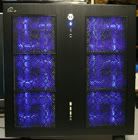
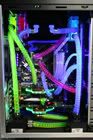
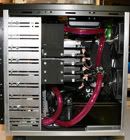
First, all real-world testing (for all the showdown articles) was done with the Poseidon AS system unless otherwise noted (see Pic #1 below):
(WC) indicates that component is water cooled
Q6600 at 3.2 (WC)/ EVGA 680i Version A1 P29 BIOS (SPP and MCP WC)/ 4 GB Dominator 9136 at 1200/ BFG 8800 GTX at 630/1900 (WC)/ BFG PhysX (WC)/ X-Fi Fatalty/ RAID 0 x 2 150 GB Raptors (Windows XP)/ RAID 0 x 2 74 GB Raptors (Red Hat and Ubuntu)/ WD Caviar 250 GB (Vista)/ WD Caviar 250 GB (Debian)/ Plextor DVD burners/ Thermaltake 1200 watt Toughpower/ Chenming 901AD case/ Alota Logitech/ Creative Gigaworks 750/ Dell 2407 and 3007 (arriving)
Notes on the PoseidonAS - My system isn't as sweet as several of the mega-rigs that I have seen here in the forums but she runs at 20 ~ 23 dBa. She is optimized more for maximum quiet than maximum overclock and hence everything runs a little on the high temp side. The Q6600 is the real gem of the CPUs out now, so dont blow hard earned money on the QX6850 when the Q6600 gives 95% of the performance at almost 25% of the price. The 680i, as already mentioned is not my favorite chipset and dont go for RAM above DDR2 6400. The Core 2 chips will not utilize the headroom very well and you will experience very little real world benefits in apps or games. The PhysX card used to just be a gimmick, but at $140 on pricegrabber, it is slowly starting to find its groove. Ubuntu outperforms Windows in almost every aspect except gaming. Just think, no validation, no viruses, and almost one-click updates. Finally, if you have extra cash burning a hole in your pocket, get a bigger monitor, believe me, it is MUCH more noticeable than another GPU to complete the SLI setup.
Additionally, all testing was done with standard Clearflex ½ inch inner diameter, ¾ inch outer diameter clear tubing (unless noted otherwise) with Dtek ½ inch outer diameter metal barbs at all junctions where applicable with black nylon snap rings clamped down to the 5th tooth on each barb. The coolant in all cases was 100% distilled water with 2 drops of biocide per liter.
Finally, I actually prefer to publish data is SI units (you know, like those oddballs in France and the other 196 countries of the world do) but since so much other work both here in the forums and at industry websites is in the English gallon – foot notation, I have decided to convert my calculations to those units to help when comparing articles.
Finally, now that that crap is outta the way, how about some pictures:
Pic #1 – The Poseidon AS in finally finished form. Obviously, Poseidon was the Greek god of the Sea, and the AS stands for 'Almost Silent' (she runs at about 23 dBa until the hard drives have to seek). The old steel Chenming case is the only oddity here but like every man with a big wife says to himself at night, it is what's on the inside that counts, right?
Pic #2 – Custom cut blowhole plate for the radiator
Pic #3 – Side view
Pic #4 – My new home setup (now where's Heidi !)

 Reply With Quote


 Originally Posted by jayhall0315


 90 elbows!!
  Amendment




Bookmarks