




Gigabyte GA-X58A-UD9 Motherboard Review
Patrick "Deux" VanValzah

First off, I'd like to make sure you know what you're going to get from this review. This isn't going to be your run-of-the-mill motherboard review where I ramble about the number of USB and SATA ports and run meaningless tests comparing motherboards and drawing conclusions from the tiny differences between boards. First, I'm going to briefly discuss the features and layout of the board keeping in mind my point of view as an overclocker. Next I'll show some results with the board and discuss how they compare to competing boards with a focus on clock-for-clock efficiency in the benchmarks used by HWBot.org. Additionally, I'll be discussing the overall experience of using the board including a few subzero sessions.
Gigabyte's X58A UD9 is many things; it's Gigabyte’s flagship X58 based board, it supports Quad-SLI and CrossfireX, and has USB 3.0 and SATA 6. Oh, by the way, it's $700 on Newegg. To be honest, I have trouble imagining a single socket X58 board that could possibly be worth $700 when the next highest priced board is right around $500 and has a similar feature set with the exception of USB 3.0 and SATA 6. Are USB 3.0 and SATA really worth $200? They certainly aren't to me, and I suspect that many others feel similarly.
Features
As this is Gigabyte's flagship Intel-based board, it has just about every feature you could imagine for a motherboard. USB 3.0 as well as SATA 6 and a pair of eSATA ports are included to cover all of your current and future storage needs.

The rear I/O Panel has everything that is expected on a high-end board. Personally, I appreciated the eSATA/USB ports as they allowed greater flexibility. At this point, having a pair of PS2 ports seems a bit over the top and I would prefer to see that reduced down to one that worked for either keyboard or mouse.

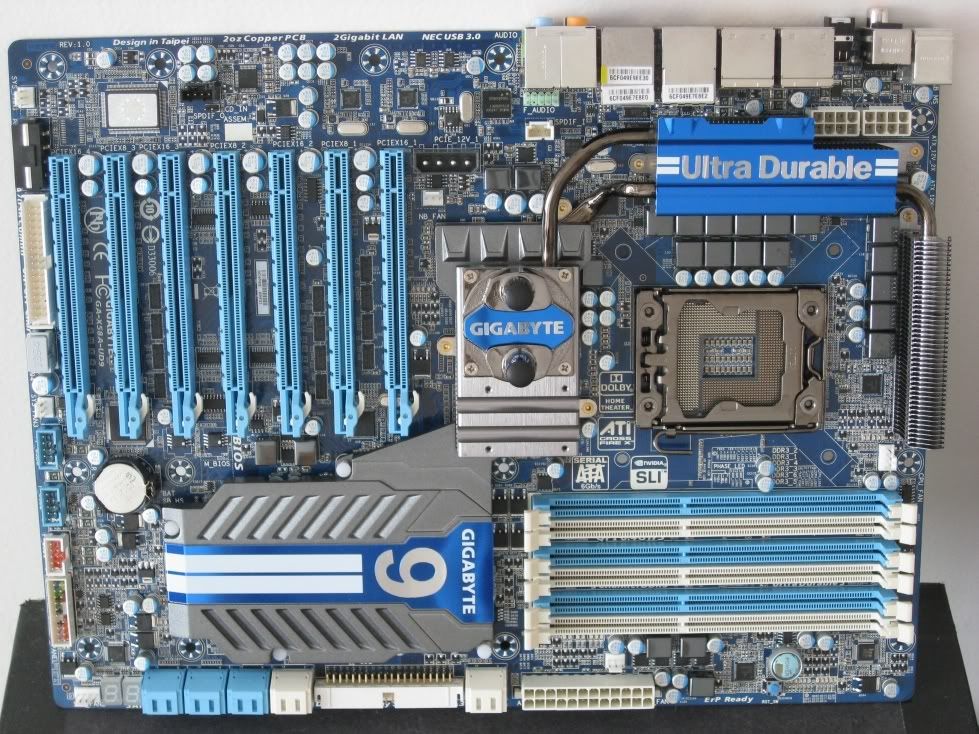
Additionally, the board includes the Nvidia chips "necessary" to enable Quad SLI. In order to make this as easy as possible the board includes a full 7 PCI-Express 16x slots.

While very handy for running multiple GPU's, this is annoying for people who would like to use a PCI post card or sound card. Also included on the board is a two-digit POST code display to make diagnosing boot issues easier, which is critical when overclocking.

If you are someone who cares about all the minor features of the board, then I'll point you over to Gigabyte's product page for the board as it does a solid job of discussing the boards features in more detail.
Layout
First the obvious - the UD9 is larger than your typical motherboard; it is both taller and wider. The width really isn't much of an issue, as it will fit comfortably into any case which accepts E-ATX motherboards. The height is more of an issue as it prevents the board from fitting into cases that have only 7 expansion slots. The UD9 also has two 8-pin EPS12V connectors to ensure that the CPU is provided all the power it needs. While I do appreciate this, the placement is less than ideal as it is a bit of a hassle to remove the power supply connectors once they have been connected.

Right above the PCI-Express slots and at the bottom of the board, a pair of 4-pin drive connectors are included to guarantee that there is enough power for the board when running multi-GPU setups.

Similar to other high-end boards the UD9 includes both power and reset buttons on the board to make using the board on an open test bench somewhat easier. While I can't really complain about this, it did bug me a bit during testing; the size difference between the power and reset buttons is a bit jarring and does make the reset button a bit hard to hit without looking for it.

Additionally, Gigabyte includes an extra heatsink that screws on to the top of the northbridge heatsink to provide extra northbridge cooling for those that will be sticking to air cooling for the board. Also included is a waterblock that cools the northbridge and allows anyone who already has a water cooling loop to cool the northbridge easily. All of this extra cooling that is included would be great if it weren’t for one thing. Both the waterblock and the extra heatsink attach to a piece of metal that attaches to fins which attach to another metal base which finally contacts the X58 IOH. Does anyone else see the problem here? There are Fins between the IOH and the waterblock.
Fins are meant to dissipate heat and not transfer it. As a result, both the extra air heatsink and the waterblock appear to have little effect on northbridge temperatures. After seeing this, I proceeded to do all of my testing with either the waterblock or extra heatsink. Throughout the course of testing the northbridge temperature never exceeded 45 degrees Celsius, which is impressively low especially compared to some of the other high-end X58 based boards. I’m going to sum up the UD9 heatisnk situation with this, if you find that you're having problems with your northbridge running too hot, odds are, you’re doing something wrong.
The CPU socket area is fairly typical. We see Gigabyte's 24 phase power delivery system and well, everything else is fairly typical of X58 boards. The MOSFET cooling around the socket is a nice height as it did not interfere with any of the cooling methods we tested including the Prolimatech Megahalems and the single stage phase change cooler which can be tough to mount on some boards.
The one thing I feel is worth mentioning from an overclocking point of view is that the area around the socket is relatively crowded which makes insulating the board for subzero runs a bit of a challenge.
Finally, the one thing that is missing from the board is a set of voltage measuring points to be able to measure the actual voltage that components are receiving. Measure points have become standard on overclocking-oriented boards and I feel that it is a significant omission. Ironically enough, the lack of measuring points hits especially hard as the voltage set in BIOS and the actual voltage differed significantly most of the time. This left me having to ask around to find measure points which turned out to be fairly inconvenient (behind the CPU socket.)
Test Setup
Motherboard: Gigabyte X58A-UD9
Processor: Intel Core i7 980X Retail
Cooling: Single stage phase change, Kingpin Cooling F1EE + LN2
Memory: Corsair Dominator GT 2000C7
Video Card: Gigabyte GTX 480
Power Supply: Antec TPQ1200
Hard Drive: OCZ Vertex and Agility SSDs
A few notes about the UD9 and its BIOS:
When I received the board it had the F1 bios. In this state it couldn't clock memory to save its life, multiple kits, multiple CPUs and it still would only run 2000 MHz with 8-9-8-x or looser timings. Thankfully, this issue was fixed in F2 and later BIOSes and is no longer an issue as the UD9 is now nearly identical to other high-end boards in terms of memory performance.
Results
(click for full screenshot)
(click for full screenshot)


All of the above results were achieved using the single stage phase change cooling unit which runs between -30C and -40C depending on the benchmark. Keeping this in mind, I'm happy with the results as the scores are all right around where they should be for a high-end board. The fact that Gigabyte has manged to keep their efficiency very close to that of boards that do not have NF200s while having two on board is impressive in my mind as most boards with NF200s on board take a slight performance hit in single card tests due to the added latency.

Now on to my favorite test, low clock SuperPi 32M. If I had to pick an area where the UD9 stood out, this would be it. Throughout testing; I was able to run 32M with my RTL values at least 1-2 settings tighter than on the E760 Classified. As a result, the UD9 enjoyed a slight clock-for-clock advantage over the E760 classified in my testing. This allowed me to achieve a new personal best for lowest frequency needed to reach a sub 7 minute 32M run.
Click for full screenshot
This final result required liquid nitrogen cooling to achieve, and while not the greatest score overall, the clock for clock efficiency demonstrates what is possible with a better CPU.
Overall, the Gigabyte X58A-UD9 proved itself to be a solid, dependable board that never gave us any problems other than the initial memory struggles. A solid feature set, combined with a well thought out layout and better efficiency than other boards make for a very respectable flagship board. Regardless, in good conscience I can't recommend it at the $700 price point it currently occupies. It's a great board but even in my efficiency oriented mind, the slightly better efficiency isn't worth anywhere near the $200 extra it costs. If Gigabyte can get the price under control and bring it back into the realm of "reason", say under $550, the UD9 will prove a very compelling choice for enthusiasts and overclockers alike.


 Reply With Quote

 Originally Posted by jayhall0315




















Bookmarks