

if theres a cheap model of this, theres no reason to not get it.
this is great for ppl who do bluray transcoding.
x264 is fully multithreaded, so ppl should get huge gains.
especially if you use constant rate factor mode instead of 2 pass mode.



if theres a cheap model of this, theres no reason to not get it.
this is great for ppl who do bluray transcoding.
x264 is fully multithreaded, so ppl should get huge gains.
especially if you use constant rate factor mode instead of 2 pass mode.
Last edited by grimREEFER; 08-11-2009 at 12:04 AM.
DFI P965-S/core 2 quad q6600@3.2ghz/4gb gskill ddr2 @ 800mhz cas 4/xfx gtx 260/ silverstone op650/thermaltake xaser 3 case/razer lachesis
Is there a 32nm QC (native or not) part with 192bit memory coming anytime?
You were not supposed to see this.
This can encode 6 WMV9 streams and deinterlace in real time.
Naw, 12 --> HT
Orochi = BulldozerOriginally Posted by kl0012

Any estimations on how big the die size will be?? I would guess around 280mm2. Also is the speed suppose to be 2.4Ghz or faster because even i7 965 had a ES with the proper speed so maybe this ES also has the correct speed??
I think 2011!! Sandy and Bull both will support 192 bit memory. That is of course only possible if Intel does not release a i7 "Westmere" before 2011. Ahh if you reallly crave it that much get a i9 :>
Last edited by ajaidev; 08-11-2009 at 02:17 AM.
I think this chip will, initially at least, have the same problem AMDs 3cores and 6cores have. Which is software not properly supporting CPUs with a core count that is not a power of 2.
Seems we made our greatest error when we named it at the start
for though we called it "Human Nature" - it was cancer of the heart
CPU: AMD X3 720BE@ 3,4Ghz
Cooler: Xigmatek S1283(Terrible mounting system for AM2/3)
Motherboard: Gigabyte 790FXT-UD5P(F4) RAM: 2x 2GB OCZ DDR3 1600Mhz Gold 8-8-8-24
GPU:HD5850 1GB
PSU: Seasonic M12D 750W Case: Coolermaster HAF932(aka Dusty)

http://en.wikipedia.org/wiki/Power_of_two
theres no six in the "power of two".
Whilst I obviously don't disagree with your post, I am wondering if the notion of having cores to the power of two matter much any more?
It appears that Intel will be bringing out a 10 core successor to the 8 core Nehalem-EX.
10? I can see them using 12, but not 10...
Donate to XS forums
There where/are some apps out there that have a "hardcoded" ammount of threads, 1,2,4 etc (power of two). If they are confronted with a cpu that has an odd number of threds (3,6,12 etc) they fall back to the next lower number.
But most apps shouldn't have a problem, cause the either don't scale past a certain number of threads or allow any number of threads.
The problem is even lower for HPC (beckton) software since there you code your software to fit the hardware its run on.

Don't get too excited about x264 performance. If you're transcoding, chances are you're using Avisynth. Avisynth kills efficiency when talking about lots of threads going at it in x264.
Particle's First Rule of Online Technical Discussion:
As a thread about any computer related subject has its length approach infinity, the likelihood and inevitability of a poorly constructed AMD vs. Intel fight also exponentially increases.
Likewise, the frequency of a car pseudoanalogy to explain a technical concept increases with thread length. This will make many people chuckle, as computer people are rarely knowledgeable about vehicular mechanics.
Rule 2:
When confronted with a post that is contrary to what a poster likes, believes, or most often wants to be correct, the poster will pick out only minor details that are largely irrelevant in an attempt to shut out the conflicting idea. The core of the post will be left alone since it isn't easy to contradict what the person is actually saying.
Rule 2A:
When a poster cannot properly refute a post they do not like (as described above), the poster will most likely invent fictitious counter-points and/or begin to attack the other's credibility in feeble ways that are dramatic but irrelevant. Do not underestimate this tactic, as in the online world this will sway many observers. Do not forget: Correctness is decided only by what is said last, the most loudly, or with greatest repetition.
Rule 3:
When it comes to computer news, 70% of Internet rumors are outright fabricated, 20% are inaccurate enough to simply be discarded, and about 10% are based in reality. Grains of salt--become familiar with them.
Remember: When debating online, everyone else is ALWAYS wrong if they do not agree with you!
Random Tip o' the Whatever
You just can't win. If your product offers feature A instead of B, people will moan how A is stupid and it didn't offer B. If your product offers B instead of A, they'll likewise complain and rant about how anyone's retarded cousin could figure out A is what the market wants.
depends on the program.
some info dugg from the article:
32nm system in the next blessing, Intel plans in the second quarter of 2010 to launch the first of six core DT processor core, code-named "Gulftown".So apparently Q2 2010 release with the Core i7-1000 moniker."According to Intel to disclose to the motherboard industry, Intel Gulftown six core eventually named after a very good chance they would not use the Core i9 family, but Core i7-1000 family, because there is no micro-architecture Gulftown changes, only the core of the increase in the number not constitute a new brand."
Faceman
Or just round up to the next power of two and let the scheduler take care of it.
Last edited by poke349; 08-11-2009 at 09:29 AM.
Main Machine:
AMD FX8350 @ stock --- 16 GB DDR3 @ 1333 MHz --- Asus M5A99FX Pro R2.0 --- 2.0 TB Seagate
Miscellaneous Workstations for Code-Testing:
Intel Core i7 4770K @ 4.0 GHz --- 32 GB DDR3 @ 1866 MHz --- Asus Z87-Plus --- 1.5 TB (boot) --- 4 x 1 TB + 4 x 2 TB (swap)
Is this going to run on current X58 boards? Thanks.
I think that article could be right about i7 branding and not using i9 but it has the wrong reasons. Westmere, like the last tick Penryn, will have micro-architecture changes. I remember reading in many places Westmere has changes to it's core, they might be minor but they are still new changes. Penryn didn't get a brand refresh or specific new brand. It adopted its tock brand Core2 Duo/Quad just with different/higher model #s. So its not that shocking that Westmere will continue the same brands as Nehalem but with higher model #s. And so far there have been 0 32nm 4core codenames or news or anouncements. 32nm with be 6/12 and 2/4 for the most part. But then again this whole iX things makes no sense anymore and its Intel so who knows!
edit: Found it.
Riiiiiiightbecause there is no micro-architecture Gulftown changes, only the core of the increase in the number not constitute a new brand."
Last edited by Tenknics; 08-11-2009 at 09:42 AM.
Iron Lung 3.0 | Intel Core i7 6800k @ 4ghz | 32gb G.SKILL RIPJAW V DDR4-3200 @16-16-16-36 | ASUS ROG STRIX X99 GAMING + ASUS ROG GeForce GTX 1070 STRIX GAMING | Samsung 960 Pro 512GB + Samsung 840 EVO + 4TB HDD | 55" Samsung KS8000 + 30" Dell u3011 via Displayport - @ 6400x2160
Yes. Though I don't know what the point of this chip, in the desktop segment, is. Now, in the server arena it does make sense if it's priced right.
There is no logic in such naming or there would be no Core i5 and Core i3, but Core i7-500 and Core i7-300.
I suppose turbo mode could be the saving grace for single threaded performance. Does anyone know how far it will go? (or will it get not much of a turbo mode á la i7)
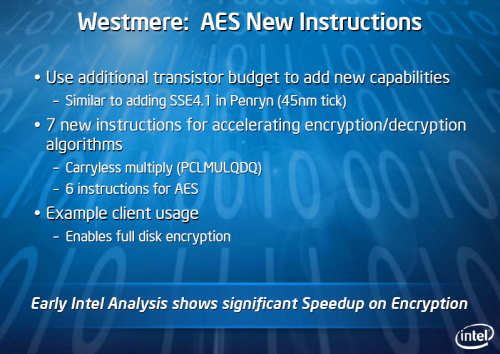
I'm a little sad to see that there are really no improvements except for AES handling, but I'm assuming it's more of a software issue. That's fine with me though, I mean even if it can do the same old things at the same old speed, it can handle 50% more of the same old things simultaneously.
Need DP version released now! 24 threads would be much nicer than 16.
I want to see this AES handling in action though. I like the example use given as full hard drive encryption, and I would love to know how much it consumes in terms of CPU resources and how much of a performance impact it is to the disk subsystem. For example, would encrypting your whole disk on a 6-core give you about the same performance as a 4-core non-encrypted system, with a slight hit to disk performance... or is it better/worse? To me this is a huge question.
Dual CCIE (Route\Switch and Security) at your disposal. Have a Cisco-related or other network question? My PM box is always open.
Xtreme Network:
- Cisco 3560X-24P PoE Switch
- Cisco ASA 5505 Firewall
- Cisco 4402 Wireless LAN Controller
- Cisco 3502i Access Point
Gulftown automatically comes with a 2nd QPI link just like Gainestown, so you can run them in 1P and 2P rigs. That's the whole point really, and the one thing AMD is missing with the Istanbuls.
I fear this AES business is pretty useless.. I ran a Truecrypt bench on my old Harper more than a year ago, as you can see it's more than fast enough arleady to handle plain 128bit AESI want to see this AES handling in action though. I like the example use given as full hard drive encryption, and I would love to know how much it consumes in terms of CPU resources and how much of a performance impact it is to the disk subsystem. For example, would encrypting your whole disk on a 6-core give you about the same performance as a 4-core non-encrypted system, with a slight hit to disk performance... or is it better/worse? To me this is a huge question.
On the Dual X5450 it's like 1,2GB/s... pretty hard getting a storage system to max out the CPus with simple AES
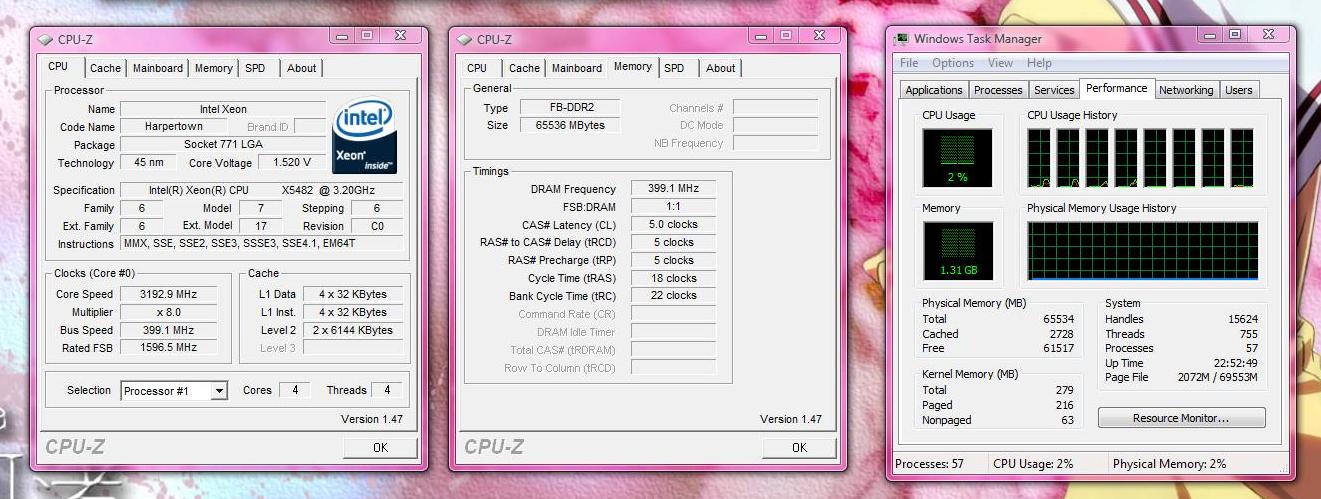
0.072v on a quad?
Voltage sensors on Harpertowns are all broken:
I have yet to see a dual-Harper rig with correct vcore readings... lol
It's defintiely not 1.5v at stock... That'll fry a chip within weeks of 100% cpu load...
Last edited by poke349; 08-11-2009 at 12:35 PM.
Main Machine:
AMD FX8350 @ stock --- 16 GB DDR3 @ 1333 MHz --- Asus M5A99FX Pro R2.0 --- 2.0 TB Seagate
Miscellaneous Workstations for Code-Testing:
Intel Core i7 4770K @ 4.0 GHz --- 32 GB DDR3 @ 1866 MHz --- Asus Z87-Plus --- 1.5 TB (boot) --- 4 x 1 TB + 4 x 2 TB (swap)
Naw.. CPU-Z still cannot to this day display Vcore correctly on Dual LGA771 systems.. is it that hard to beleive?
Vcore on the E5420 was 1,14V load or something.
@poke: It's not the sensor that's broken, just CPU-Z. Everest for example displays the Vcore accurately on Harpertown-Systems.
I get the same wrong readings from CPUz, Speed Fan, and believe-it-or-not, the BIOS... 1.5v for cpu-0 and 1.1v for cpu-1...
Maybe they're all reading it incorrectly.
EDIT: Even when I switch the two processors, same readings 1.5 for cpu-0 and 1.1 for cpu-1.
Main Machine:
AMD FX8350 @ stock --- 16 GB DDR3 @ 1333 MHz --- Asus M5A99FX Pro R2.0 --- 2.0 TB Seagate
Miscellaneous Workstations for Code-Testing:
Intel Core i7 4770K @ 4.0 GHz --- 32 GB DDR3 @ 1866 MHz --- Asus Z87-Plus --- 1.5 TB (boot) --- 4 x 1 TB + 4 x 2 TB (swap)
 Posting Permissions


 Reply With Quote



Bookmarks