

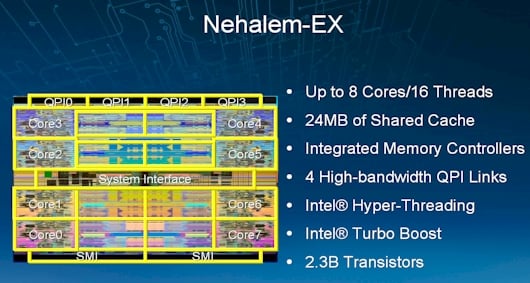
Now lets see the transistor count of Nehelem EX/Beckton, Nehalem EX and Magny-Corus:
2.3B "Beckton" < 1.8B "Magny-Corus" < 1.2B "Westmere"
<
<
Here is the list:




Now lets see the transistor count of Nehelem EX/Beckton, Nehalem EX and Magny-Corus:
2.3B "Beckton" < 1.8B "Magny-Corus" < 1.2B "Westmere"
Here is the list:
Last edited by ajaidev; 03-30-2010 at 02:44 AM.
Coming Soon
Very impressive results for AMD!
But these are only synthetic benchmarks, I think core scaling in real applications would be more interesting to have a look at.
Donate to XS forumsOriginally Posted by jayhall0315

when will we see nehalem-ex benches?
Soon i was under the impression it was to be launched this week maybe i recalled it wrong
Anyways it does not appear as elegant as Westmere just because of the fact that it is made on 45nm. I would guess its around 570mm2 and the biggest advantage over either MC or WM is the huge L3.
HPC is where the fight will lay . The AMD's higher end 12 cores are quite good for HPC app's i would imagine so is nehalem-ex. The real question would be do you need a 8P system or a 4P system i would imagine people getting a choice between AMD 6176 SE and x7550
But Intel has a variance in L3 cache from x7550 and x7560. X7550 has around total of 20MB cache and AMD 6176 SE has total of 19.6MB cache.
Coming Soon
I saw the spec-int and fp results before so no surprise here but the spec_power is something i didn't expect at all.
at least there si competition again.
official intel launch is tomorrow, not sure how many reviews and benchmarks will be available.
real apps plz
synthetic benching is just a warm up
---
---
"Generally speaking, CMOS power consumption is the result of charging and discharging gate capacitors. The charge required to fully charge the gate grows with the voltage; charge times frequency is current. Voltage times current is power. So, as you raise the voltage, the current consumption grows linearly, and the power consumption quadratically, at a fixed frequency. Once you reach the frequency limit of the chip without raising the voltage, further frequency increases are normally proportional to voltage. In other words, once you have to start raising the voltage, power consumption tends to rise with the cube of frequency."
+++
1st
CPU - 2600K(4.4ghz)/Mobo - AsusEvo/RAM - 8GB1866mhz/Cooler - VX/Gfx - Radeon 6950/PSU - EnermaxModu87+700W
+++
2nd
TRUltra-120Xtreme /// EnermaxModu82+(625w) /// abitIP35pro/// YorkfieldQ9650-->3906mhz(1.28V) /// 640AAKS & samsung F1 1T &samsung F1640gb&F1 RAID 1T /// 4gigs of RAM-->520mhz /// radeon 4850(700mhz)-->TRHR-03 GT
++++
3rd
Windsor4200(11x246-->2706mhz-->1.52v) : Zalman9500 : M2N32-SLI Deluxe : 2GB ddr2 SuperTalent-->451mhz : seagate 7200.10 320GB :7900GT(530/700) : Tagan530w
hmm,
wonder for that 75xx prices...
8/16 up to 8 socket, yamee..
would love to get some ES's of these.
Since the target market here is partially against HPC legends such as POWERPC and SPARC, I can't wait to see how these compare. Heck, I can't wait to see how these compare to the new Beckton's.
Core I7 920 4.2 ghz (21x200) 1.35 volts / Asus P6T / Corsair XMS 1333mhz @ 1600mhz / EVGA GTX 285 SSC (724 core/1634 shaders / 1508 mem) / Modified ThermalTake Armor
Swiftech Apogee, MCW-60, Swiftech 655, Black Ice GTX 360
Nice to AMD in the mix again
GA-X58A-UD3R
980x with apogee XT WB
Xonar D2X
Corsair Dominator 1600C7 12 Gig
enermax Galaxy 1000w
EVGA 580GTX
OCZ V2E 120 + 2x1T F1's
P.A 120.3 rad
EP-Uk lian li G70 case
Please note that the 6174 results are not our top bin, there is another beyond that. We supplied the 6174 because we knew that we could make a compelling argument for value. When a 6174 beats an X5680 it is beating a processor that eats more power and costs 42% more ($1165 vs. $1663).
There were a lot of critics that jumped on AMD about MC clock speeds, I am interested in their take on the Beckton clock speeds, especially combined with the TDPs.
Has anyone seen any SPEC power numbers yet? Data seems pretty light at this point. Wasn't happy with the infoworld review, who uses big boxes like either of our platforms for MP3 encoding....?
^^ Yup or the virii that said 45nm was impossible without HKMG. Maybe they meant intel couldn't make 45nm products without HKMG, that would make sense. But AMD's SOI process simply kicks a$$.
Or the virii that said AMD couldn't compete with intel's 32nm process. Not only can it compete, but their 45nm products can outperform intel's 32nm products, while using less power!. Pretty amazing work.
Actually, I stumbled across the beckton power numbers on tec channel.
I was slapped down earlier for the simple comment "it looks hot" about Beckton.
At least I was vindicated on that one.
Too many people are getting wrapped up in raw performance, when so few people actually buy top core processors. It's pretty much price/performance or performance per watt (or, increasingly, both) that are really driving ther server decisions.
I think the sooner everyone accepts that there is something more important than raw performance, the sooner we'll be able to get down to real constructive discussions.
A lot of value that's lost for applications whose license costs are on a per core basis.
As expected, it's a monster for commercial workloads with unprecedented RAS features for x86 and staggering memory capacity.There were a lot of critics that jumped on AMD about MC clock speeds, I am interested in their take on the Beckton clock speeds, especially combined with the TDPs.
Intel says 2927 for an IBM x3650, haven't seen any numbers from AMD.Has anyone seen any SPEC power numbers yet? Data seems pretty light at this point. Wasn't happy with the infoworld review, who uses big boxes like either of our platforms for MP3 encoding....?
Last edited by accord99; 03-30-2010 at 08:57 PM.
It doesn't compete, which is why AMD has to go down the frequency/voltage curve to get more cores. At least in this way, they can compete with Intel in throughput which they otherwise could not if they pushed the limits of their process.
I agree with the first one. However, keep in mind than this place is full of enthusiast that usually go for whatever performs higher no matter the price, and most ultra high end part delivers very little value for the money besides bragging rights.
I always look for value (Price/performance), but I also see power consumption, platform cost, and all that. AMD always had given the most value where it matter the most (Budget) and better than Intel value in every other segment. However, as a sort of AMD fanboy, I like to both provide value, and seeing you topping the charts like in the K8 golden era. But from Conroe introduction that is hard to see.
Actually, I though that most licenses were per Socket and not per amount of Cores. Or are SMT supporting Processors charged twice what they actually are?
Some applications are still only licensed on a core basis, like the HPC applications in the anandtech test and they're far more expensive than the CPUs.
sorry to get into u'r discussion, even as relatively nwby, this review just seemed stupid.Wasn't happy with the infoworld review, who uses big boxes like either of our platforms for MP3 encoding....?
The " per core" license argument is generally a red herring.
There are several ways that server software is licensed:
By server
By named user
By socket
By core
By thread
Of all of the licensing schemes, by core is the only one where core count matters. We had our software team go back and look at the number of packages that do by core licensing and came out with a number that somewhere north of 95% of the applications (by market TAM) are not impacted by core counts.
The number of by core licenses are pretty limited, not in the mainstream.
The 2 biggest examples brought up are:
1. Fluent. Yep, we have a disadvantage here
2. Certian Oracle applications. (not all, just some, as Oracle uses a mixture of the 5 options above - yeah, confusing to say the least).
But for #2, Oracle pushes site licenses on their customers, generally making the licensing by core irrelevant.
Theoretically you could put some of VMware Vsphere into this class, but, by moving to the enterprise license from the lower grade, you can consolidate more, and get more VMs on fewer platforms, there is a net financial gain on the whole transaction by going with AMD.
Beckton has 8 cores, we have 8 cores on Magny Cours (if you are worried about core licensing.) So, if we need to, we can be at parity from a licensing perspective.
 Posting Permissions




 Reply With Quote


Bookmarks